
Problem
The fastest way to waste time building an AI agent is to start with everything it might eventually do.
Broad capability sounds ambitious. It usually produces vague requirements, expanding integrations, unclear authority, and a demonstration that is difficult to evaluate.
Leaders do not need their first agent to manage an entire function. They need it to complete one useful job reliably enough that someone would choose to use it again.
That distinction matters for founders, product leaders, and operating executives under pressure to show value quickly. The first question should not be, “How intelligent can we make the agent?”
It should be, “What completed work would make this agent worth keeping?”
A useful agent is not defined by how much it can do. It is defined by how clearly it can finish.
Insight
An AI agent combines a model, instructions, and tools to work toward a goal. It can retrieve information, choose among permitted actions, and adjust its next step based on what it finds.
That flexibility is valuable when the path varies, but the intended outcome remains stable.
Consider vendor invoice review. One invoice may match the original statement of work. Another may require finding an approved change order, checking delivery evidence, or identifying a rate that does not match the agreement.
The path changes. The job does not.
That makes the workflow a reasonable candidate for an agent. But “manage our vendors” is not a workable assignment. It combines document review, contract interpretation, communication, approval, payment, and relationship management into one undefined mandate.
A better assignment is:
Review a vendor invoice against the approved statement of work and change orders, identify discrepancies or missing evidence, and prepare questions for the finance manager.
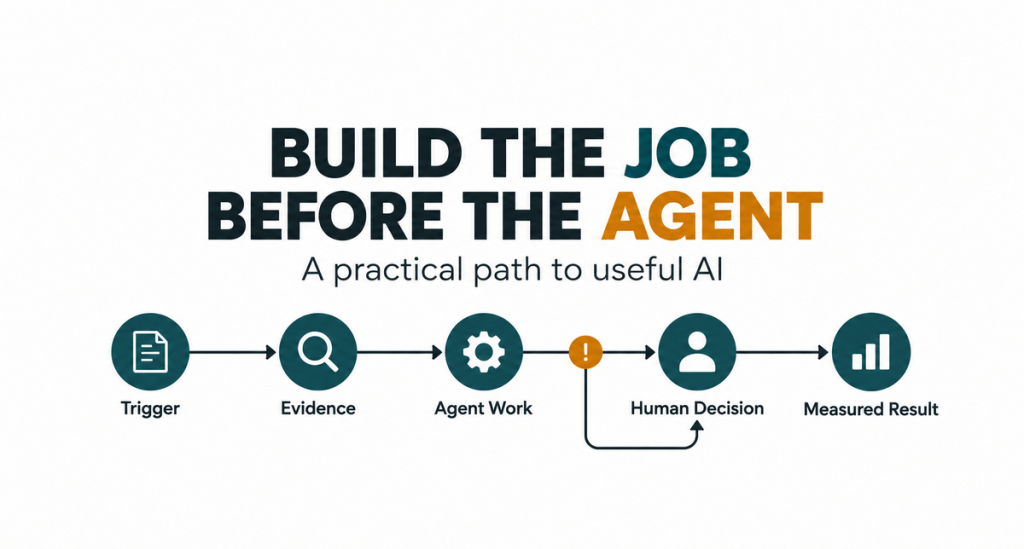
Now the agent has a recognizable trigger, a defined evidence set, a checkable deliverable, and a clear human decision owner.
The first version can create value without being allowed to approve or pay anything.
Example
Imagine an operations team that spends 45 minutes reviewing each professional-services invoice.
The reviewer must locate the approved statement of work, confirm the contracted rates, verify whether additional work was authorized, and find evidence that the relevant deliverables were accepted. Documents are stored across a project folder and an email archive.
The team grants an agent access only to invoices, approved agreements, approved change orders, and designated delivery records. Draft agreements and general vendor correspondence are excluded from the authoritative evidence set.
For each charge, the agent must return one of three classifications:
- Supported by the available evidence
- Inconsistent with the approved terms
- More information required
Suppose the invoice includes 12 hours of additional testing. The agent finds an email discussing the work but no approved change order. It does not declare the charge invalid or infer approval from the conversation.
Instead, it reports:
The invoice includes 12 hours of additional testing. No approval for this work was found in the supplied statement of work or approved change orders. Ask the vendor or project owner for the applicable authorization.
The finance manager still owns approval. The agent gathers evidence, performs the comparison, cites its sources, and prepares a list of unresolved questions.
The team can now measure whether it reduces review time, finds known discrepancies, cites the correct documents, and avoids raising unsupported concerns.
That is a useful first agent. It completes a real job while keeping consequential authority with the responsible person.
Framework
A minimum useful agent requires five decisions.
1. Define one completed job
Describe the assignment in one sentence.
Avoid mandates such as “support procurement” or “improve customer service.” Name the trigger, the work, and the deliverable.
A useful template is:
When [trigger] occurs, the agent will use [sources and tools] to produce [deliverable].
If the sentence keeps growing, the first version is probably carrying too many jobs.
2. Make the output checkable
Decide what the agent must produce and how a reviewer will assess it.
For an invoice-review agent, the output might include:
- An invoice summary
- A line-by-line comparison
- References to supporting evidence
- Missing information
- Questions requiring human follow-up
The output should help someone make a decision. A polished summary without evidence may be fast to generate but expensive to trust.
3. Put the evidence in order
Identify which sources are authoritative, which are supporting context, and which must not be treated as approval.
An approved change order is different from an email discussing a possible change. A signed agreement is different from a draft. An invoice is a request for payment, not evidence that delivery occurred.
Define what the agent should do when documents conflict or essential evidence is missing. “I cannot complete this check because the approved change order is unavailable” can be a better result than a confident guess.
4. Limit authority before adding autonomy
Specify what the agent may read, create, recommend, and change.
The first version may be allowed to retrieve approved documents and create a draft review. It should not automatically approve an invoice, contact the vendor, or initiate payment.
Apply these limits through system permissions, not only written instructions. Also define stopping conditions, retry limits, escalation rules, and the human owner for blocked cases.
5. Test the mistakes that would matter
Do not test only the clean example used in the demonstration.
Use cases with known outcomes:
- A fully correct invoice
- An incorrect rate
- An approved additional charge
- Missing delivery evidence
- Conflicting agreement versions
- A duplicate invoice
- A tool or source failure
Measure issue detection, unsupported findings, source accuracy, review time, and correction effort.
An agent has not created value merely because it produced an answer faster. It creates value when the completed workflow becomes faster or more reliable after human verification is included.
Takeaway
Organizations often make agent development harder by starting with a broad vision and discovering the operational details later.
Reverse the sequence.
Choose one recurring job. Define the evidence. Specify the deliverable. Limit the authority. Test the costly mistakes. Then expand the agent only after the first workflow produces measurable value.
Complete this sentence before selecting a platform:
When [trigger] occurs, the agent will use [sources and tools] to produce [deliverable]. The work is complete when [checks pass]. It will request help when [specific condition occurs].
If that sentence is difficult to write, the workflow is not ready to automate.
Build the job first. Then build the agent around it.


Leave a Reply