
Problem
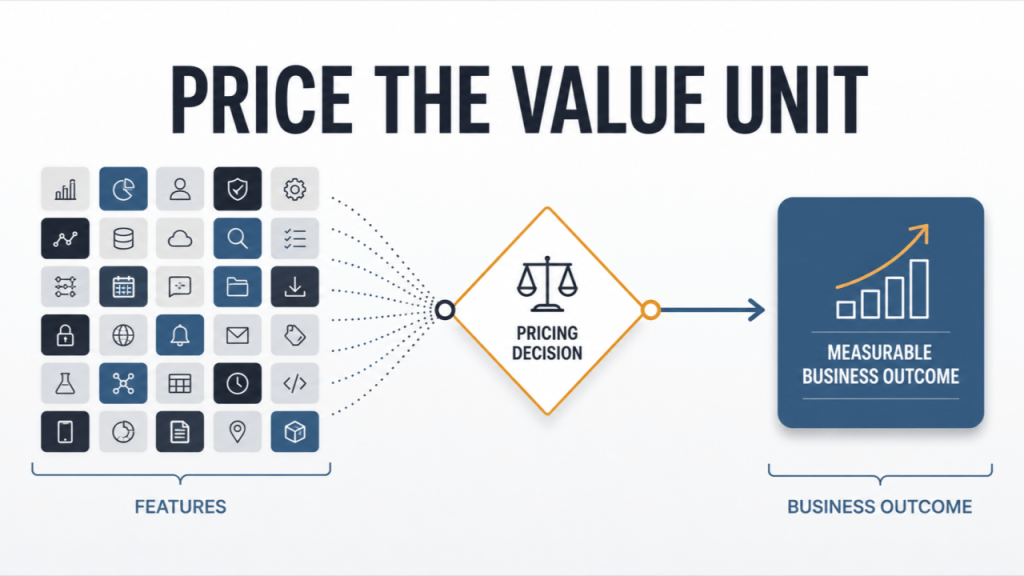
Technical founders often price what they built. Buyers fund what changes.
When an offer is priced by seats, features, compute, or development effort while the buyer justifies it through faster reviews, higher throughput, or lower operating costs, the commercial model begins with a mismatch.
That mismatch usually appears during pricing conversations. The founder explains technical sophistication. The buyer asks how the number connects to the business case. Without a clear answer, the discussion shifts toward discounts, pilot pricing, or feature comparisons.
The product may be differentiated. The price still feels arbitrary.
This is not simply a pricing problem. It is a commercialization problem because the company has not identified the measurable event that connects product use to customer value.
Insight
A useful value unit is the smallest observable event that demonstrates the product is doing commercially meaningful work.
Depending on the offering, that unit might be:
- A case reviewed
- A claim triaged
- A report completed
- A member interaction resolved
- A site brought online
- A workflow exception prevented
The right unit gives the founder, buyer, and budget owner a shared way to discuss volume, value, proof, and expansion.
It does not require pure outcome-based pricing. Vendors should be careful about tying fees to results they cannot fully control. But the commercial model should still have a visible relationship to the operating outcome the buyer cares about.
A price is strongest when the buyer can explain the meter without explaining the product.
This matters especially for technical products with broad capabilities. Pricing by features encourages comparison with other tools. Pricing around a credible value unit helps the buyer understand why the product belongs in the operating model at all.
Example
Consider an anonymized workflow platform serving research organizations.
The initial commercial model was based on user licenses. That seemed logical because users accessed the platform to organize source material, classify documents, and support evidence reviews.
In practice, most users logged in only during particular project stages. Procurement saw inconsistent seat utilization, while project leaders worried that adding occasional reviewers would increase costs. The pricing model created friction even though the underlying workflow was valuable.
The more meaningful operating event was the completion of an evidence review.
Each review moved through intake, automated classification, analyst review, and senior validation. The operations director owned the economic consequence because review volume affected contractor hours, turnaround time, and project capacity.
The commercial package was reframed around annual bands of completed reviews, supported by a minimum platform fee and defined overage rules. Bespoke data remediation remained outside the standard package because its effort varied substantially by source.
The proof model also became clearer. Instead of measuring logins, the team could track completed reviews, median turnaround time, and the senior-reviewer correction rate. The data-ingestion boundary and implementation owner were defined before the engagement started.
The change did more than create a different price sheet. It connected the product, proof model, and buying decision around the same operating event.
Framework
Before setting or revising the price, technical founders should answer five questions:
- What event creates visible value? Identify the completed action that matters operationally, not merely a feature being used.
- Who owns its economic consequence? Find the leader accountable for the associated capacity, cost, revenue, risk, or service outcome.
- Can the event be measured consistently? The unit should be observable and auditable without requiring a debate over attribution every month.
- Can the buyer predict the spend? Use minimums, volume bands, caps, or overage rules to give the buyer reasonable budget certainty.
- Which exceptions require separate scope? Custom integrations, data cleanup, unusual review requirements, and professional services should not quietly distort the standard unit economics.
If these questions cannot be answered, the company may not yet understand its value model well enough to defend its pricing.
That is useful information. It tells the founder where more customer discovery, workflow analysis, or commercial testing is needed.
Takeaway
Founders do not need a clever pricing formula. They need a defensible connection between product use, operating value, and customer spend.
Start by identifying the event the buyer wants to produce more quickly, reliably, or economically. Then build the package, proof model, and pricing logic around that event.
Do not ask only, “What will customers pay?”
Ask, “What measurable unit makes the value understandable enough to fund?”
That question leads to a stronger commercial model and a better buying conversation.
Does your pricing reflect the value customers receive? BergTec can help clarify your value proposition, pricing logic, and commercial model. Discuss a commercialization review ↗


Leave a Reply