
Problem
The model can stay the same while the production decision changes.
That is why model version control is not enough for AI governance.
A new prompt, retrieval index, confidence threshold, tool permission, or handoff rule can materially change what an AI-enabled workflow recommends and what employees do next. When these changes are treated as routine technical updates, leaders can lose control of the operating outcome without realizing anything significant was released.
Many organizations govern the most visible component: the model. They document which version is in use, review major upgrades, and monitor familiar quality measures.
That creates a dangerous sense of control.
The production workflow contains several other moving parts. Its source data changes. Prompts are revised. Business rules are adjusted. Integrations expose new actions. Review thresholds move. Employees learn new ways to interpret the output.
Any one of those changes can alter the result that matters to the business.
Insight
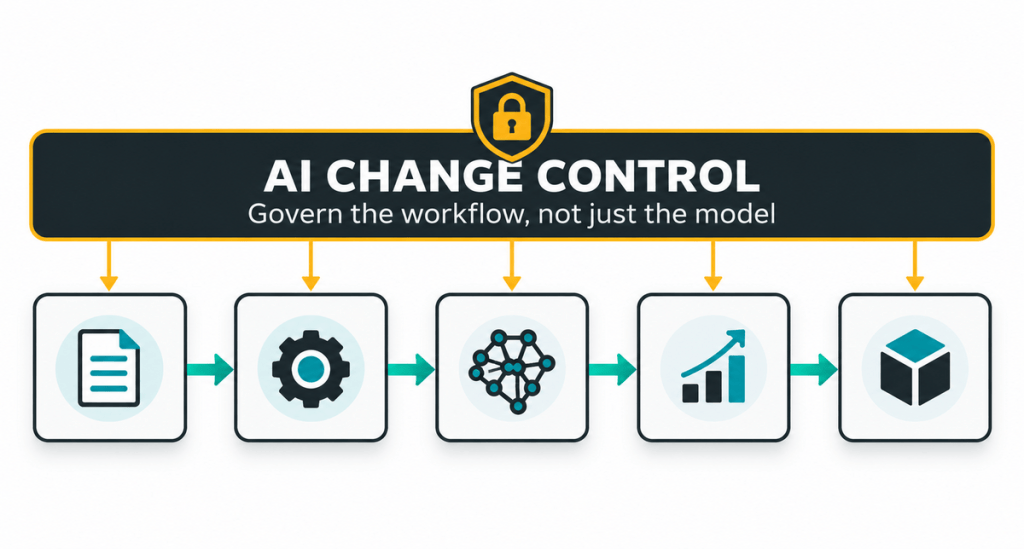
The governed unit should be the workflow, not the model.
This does not mean every wording adjustment needs an executive committee. It means the organization needs a practical way to distinguish a minor technical change from a material operating change.
A material change is one that can affect:
- which evidence the system uses
- which cases receive human review
- what actions the system may recommend or execute
- how an exception is handled
- who becomes accountable for the result
- how customers, employees, or partners experience the decision
This is where conventional software release practices can fall short. A component may pass its technical tests while the end-to-end workflow becomes less reliable.
The model is only one moving part. The workflow is the governed product.
Leaders should therefore ask a broader question before approving production use: Can we identify, test, authorize, observe, and reverse every change that could alter the operating decision?
Example
Consider an anonymized pattern involving an AI assistant for industrial field-service technicians.
The assistant searched approved equipment manuals and service bulletins, then recommended diagnostic steps. Technicians had to confirm the equipment model and review the cited source before acting on a recommendation involving a safety-sensitive component.
The model itself did not change during one release. Three other things did:
- the retrieval index was refreshed with new service bulletins
- the prompt was shortened to produce faster answers
- the confidence threshold for displaying a recommendation was lowered
Each change appeared reasonable in isolation.
Together, they caused newer service bulletins to outrank portions of the core safety manual in several test cases. The answers remained fluent and technically plausible, but some recommendations presented an incomplete diagnostic sequence.
The team corrected the issue by treating the entire workflow as the release unit.
Product operations became the release owner. Safety engineering had to approve changes affecting safety-related equipment classes. A set of known diagnostic cases was tested against the complete source, prompt, threshold, citation, and technician-review path. Releases were staged to a limited technician group, and the prior configuration remained available for immediate rollback.
The team also monitored citation coverage, technician overrides, safety escalations, and first-time resolution rates.
The important lesson was not that retrieval systems are unreliable. It was that workflow behaviour had changed without a model update.
Framework
Leaders can establish practical AI change control by answering five questions.
1. What counts as a material change?
Define which prompt, data, retrieval, permission, threshold, integration, and review-rule changes require formal assessment. Base materiality on operating impact, not the technical size of the update.
2. Who owns the release decision?
Name one accountable workflow owner. Technical teams can validate components, but someone must decide whether the complete workflow is ready for operational use. High-risk changes may also require approval from security, compliance, safety, or another domain owner.
3. What must be tested end to end?
Test representative decisions, known edge cases, evidence quality, human handoffs, and exception paths. A model evaluation alone will not reveal whether a changed source hierarchy or review threshold has weakened the workflow.
4. How will exposure be staged?
Use limited users, bounded case types, or controlled transaction volumes before broad release. Define the signals that permit expansion and the signals that stop it.
5. How will the organization recover?
Keep the previous working configuration available. Name the person authorized to pause or reverse the release. Record which prompts, sources, thresholds, permissions, and integrations produced each material outcome.
A rollback plan is not a technical courtesy. It is part of the operating control.
Takeaway
AI governance cannot end with a model registry and an approval policy.
Production behaviour emerges from the combination of the model, evidence, instructions, rules, permissions, integrations, and human decisions around it. Leaders who govern only the model may approve one system and unknowingly operate another after several routine updates.
Treat the workflow as the release unit. Define material changes, assign an owner, test the complete decision path, stage exposure, and make recovery possible.
That is how AI change becomes deliberate operating progress instead of silent drift.
Assess your AI workflow before the next change.
BergTec can help assess an AI workflow, identify gaps in ownership, human review, testing, and change control, and define practical next steps. Tell us which workflow you are considering or already using, and what needs to improve.
We will respond within two business days.


Leave a Reply