
Problem
Revenue can rise while product-market fit remains weak.
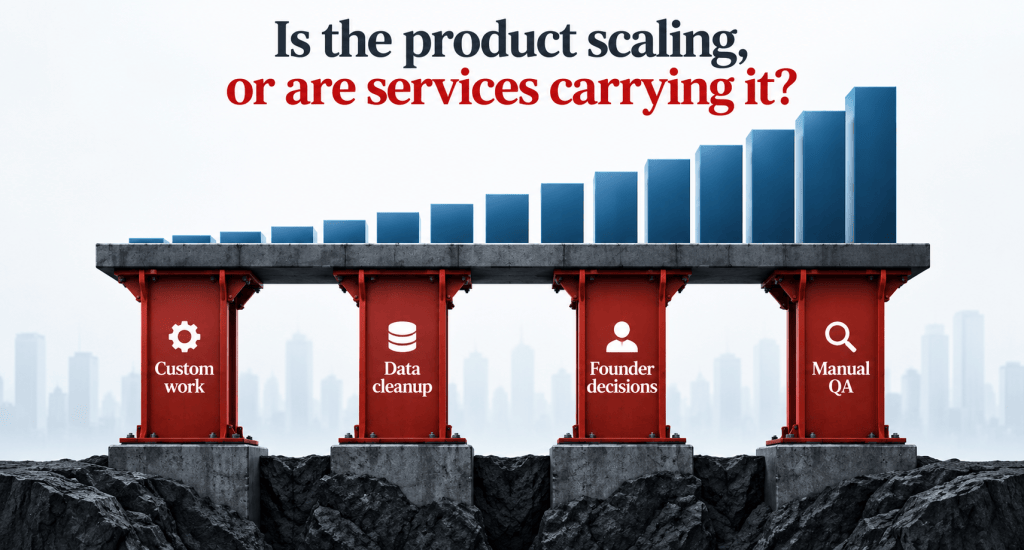
If every new customer requires custom work, founder judgment, manual quality control, and a different implementation path, the company may be selling successful projects rather than a repeatable product.
That distinction is easy to miss in a board meeting. Bookings are growing. Recognizable customers are signing. Renewal conversations sound positive.
But the operating evidence may tell a different story:
- Implementation effort increases with every contract.
- Product leaders keep approving customer-specific exceptions.
- Senior technical staff remain essential to routine deployments.
- Customer success teams perform work the product was expected to handle.
- Gross-margin forecasts exclude significant delivery effort.
The revenue is real. The conclusion drawn from it may not be.
Insight
Services are not inherently a problem.
They can accelerate implementation, expose workflow realities, and help a company learn what customers actually need. In complex enterprise, healthcare, research, or regulated markets, some service component may be necessary.
The risk appears when leadership cannot distinguish between services that enable the product and services that compensate for what the product cannot yet do.
That difference matters to boards and investors because the two models scale differently.
A product company should become more repeatable as it learns. Common requirements should move into the product, implementation decisions should become easier to standardize, and delivery effort per customer should become more predictable.
If revenue grows while those dependencies remain unchanged, the company may be adding customers without building leverage.
Revenue quality depends on what the company must repeat to earn it.
A board therefore needs more than annual recurring revenue, pipeline, and customer logos. It needs evidence showing whether growth is making the operating model stronger or simply making the delivery burden larger.
Example
Consider a B2B analytics platform selling to enterprise operations teams.
Revenue was growing, and several customers had expanded their contracts. On the surface, those results looked like strong product-market fit.
The delivery review exposed a more complicated pattern.
Each deployment required approximately 180 hours of data mapping. The founder still wrote customer-specific business logic because the configuration rules were not documented. Customer success manually reconciled reports before executive reviews, and much of that work was not priced separately.
The company was winning customers, but every sale created another customized operating commitment.
Leadership responded by drawing a clearer boundary around the product. The team introduced a standard data contract, defined which configuration options were supported, and required executive approval for exceptions outside that boundary. Repeated customer logic was prioritized for the core product instead of being rebuilt during implementation.
The board also began reviewing two operating measures alongside revenue: time to production and product gross margin after implementation and recurring manual work were included.
The immediate result was not a more impressive growth story. It was a more credible one.
Management could now show which customers fit the repeatable model, where service effort remained necessary, and whether each product release was reducing delivery dependence.
Framework
Boards can use five questions to test whether the product is scaling or services are carrying it.
1. Repeatability: What must be rebuilt for each customer?
Separate standard implementation work from customer-specific engineering, data preparation, workflow design, and reporting. A process is not repeatable merely because the team has completed it several times.
2. Dependency: Who remains essential to delivery?
Identify where deployments still depend on the founder, a senior architect, or one experienced customer leader. Then ask whether that person is contributing differentiated expertise or compensating for an undefined process.
3. Economics: Are all delivery costs visible?
Measure product gross margin after including implementation support, manual review, exception handling, and recurring customer-specific work. Unpriced services do not disappear because they are recorded in another department.
4. Learning: Is repeated work changing the product?
Customer-specific effort can be valuable when it produces reusable capability. The board should ask what recurring requirements have been standardized, automated, incorporated into the roadmap, or deliberately excluded.
5. Trajectory: Is delivery dependence decreasing?
Review time to production, implementation hours, exception volume, specialist involvement, and recurring manual work by customer cohort. The important question is not whether services exist. It is whether the company is learning how to need less of them.
These questions do not require management to eliminate services. They require leadership to be honest about the role services play in the growth model.
Takeaway
Boards should not treat revenue growth as self-evident proof of product-market fit.
They should examine what the organization must do after the contract is signed, which dependencies repeat across customers, and whether the economics remain attractive when the full delivery model is counted.
A services-supported product can become a strong, scalable business. But that transition requires deliberate product decisions, clear implementation boundaries, and evidence that operating leverage is improving.
The board’s job is not to ask whether customers are buying.
It is to ask whether the company is becoming more repeatable each time they do.


Leave a Reply