
Problem
Quantum computing does not need to be ready for every workload to change your 2030 strategy.
It only needs to become useful for a few high-value problems before your organization is ready to act.
That is the commercial risk. Leaders who wait for certainty may discover that hardware access was not their real constraint. Their constraint was the time required to identify a valuable problem, build internal expertise, prepare the data, redesign the workflow, and establish the right partnerships.
BCG reports that enterprise spending on quantum computing reached approximately $550 million in 2025, with enterprise end users surpassing government and academic investment for the first time. Its modelling places the 2030 quantum market between $2.5 billion and $5 billion, depending partly on algorithmic progress and enterprise readiness. BCG
This does not mean every company needs a quantum computer.
It means 2030 should be treated as a capability-building deadline, not a procurement date.
Insight
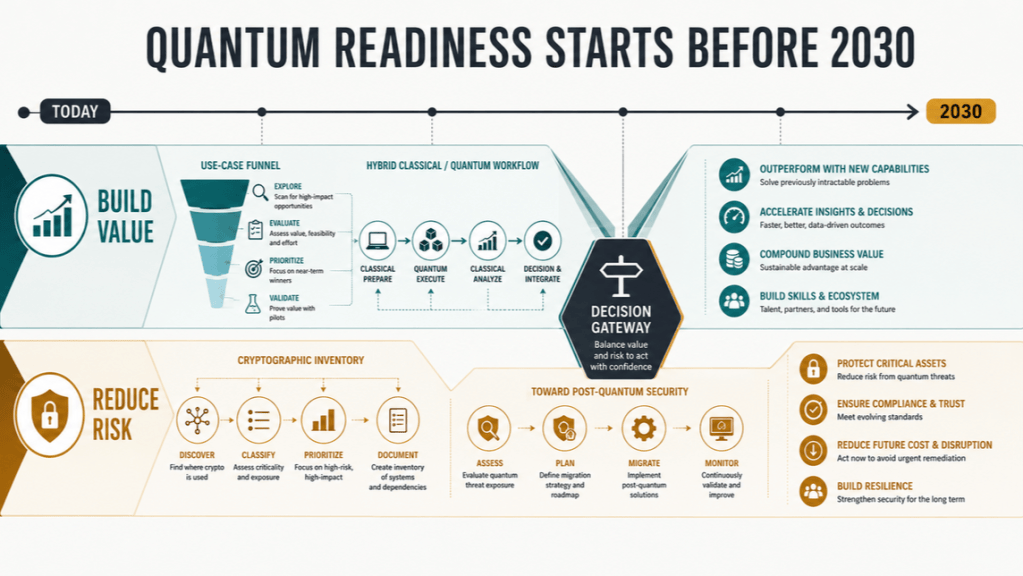
Two clocks are now running.
The first is the value clock.
Technical progress is making it harder to dismiss quantum computing as permanently distant. Google’s Willow research demonstrated below-threshold quantum error correction: as the error-correcting code grew, the logical error rate fell. In 2025, Google also reported that its Quantum Echoes algorithm ran 13,000 times faster than the best classical method tested for that specific problem. These are not proof of broad commercial utility, but they reduce an important technical uncertainty. Nature, Google Quantum AI
The second is the security clock.
A sufficiently capable quantum computer could eventually threaten widely used public-key cryptography. NIST finalized its first three post-quantum cryptography standards in 2024 and now encourages organizations to begin migrating. It also warns that long-lived encrypted data can be captured today and held for later decryption. NIST
These clocks require different responses.
On the value side, leaders need disciplined experimentation around business constraints that classical computing does not solve well enough.
On the security side, they need cryptographic visibility, migration ownership, and vendor accountability.
The mistake would be turning both into a broad innovation program with no commercial decision behind it.
The deadline is not when quantum arrives. It is when waiting makes learning more expensive.
Example
Consider a common readiness pattern in an industrial materials company.
The initial quantum portfolio contains 12 ideas: supply chain optimization, production scheduling, catalyst simulation, battery chemistry, pricing, and several machine learning concepts. All sound promising. None is defined well enough to fund.
The team narrows the portfolio to one catalyst-simulation workflow in which classical modelling is expensive and an improved result could influence a high-value R&D decision.
A vice-president of R&D owns the business question. An enterprise architect defines the handoff between the existing high-performance computing environment and an external quantum provider. Proprietary molecular data remains within a restricted boundary, with only approved representations entering the experimental environment.
The team establishes a classical baseline for accuracy, runtime, and cost. It then sets a twelve-week evidence gate: continue only if the hybrid approach produces a measurable improvement or creates reusable technical knowledge that justifies another investment cycle.
In parallel, the security team inventories where public-key cryptography protects long-lived research data, certificates, third-party connections, and embedded systems. Each exposure is assigned a system owner, a vendor dependency, and a migration priority.
This is not a bet that quantum will solve the problem next quarter.
It is a controlled way to acquire commercial evidence, integration knowledge, and security readiness before those capabilities become urgent.
Framework
Leaders can structure quantum readiness around five decisions:
1. What constraint is valuable enough to investigate?
Start with a business problem, not a technology demonstration. Identify where simulation, optimization, or modelling limitations delay a consequential decision or create material cost.
2. What evidence would show an advantage?
Define the classical baseline and the required improvement in accuracy, runtime, cost, or decision quality. A technical result without a business threshold is still research.
3. Where would quantum fit into the workflow?
Treat quantum as a specialized accelerator within a broader classical environment. Map the data inputs, system handoffs, human review, decision owner, and exception path before selecting technology.
4. What capability must the organization build or access?
Decide which knowledge belongs internally and which can come from universities, vendors, cloud platforms, or strategic partners. A small, cross-functional team that connects domain expertise, product management, and architecture may be more valuable than a large, isolated lab.
5. What information must become quantum-safe?
Build a cryptographic inventory. Prioritize data by secrecy life, migration time, system criticality, and third-party dependency. Post-quantum migration is an operating program, not a future software update.
Takeaway
Quantum computing remains uncertain. Timelines will move, vendor roadmaps may change, and many proposed applications will not produce a commercial advantage.
But uncertainty is not a reason to remain unprepared.
The organizations best positioned for 2030 will not necessarily be those that spent the most on quantum experiments. They will be the ones who can identify a valuable constraint, test it against a credible baseline, integrate the capability into a real workflow, and protect sensitive information as the market develops.
Do not ask only, “When will the hardware be ready?”
Ask, “How long will it take us to become ready to use it?”


Leave a Reply