
Problem
A pilot that proves AI can produce an answer is not yet worth funding.
A fundable pilot proves that the organization can use that answer to improve a consequential business decision.
That distinction is often lost when leadership teams review AI initiatives. The presentation focuses on model performance, user enthusiasm, or the speed of a controlled demonstration. Those signals can justify further investigation, but they do not establish an investment case.
The harder questions usually come later:
Can the pilot improve the complete workflow rather than one task?
Will people use it under normal operating conditions?
What review work, integrations, and exception handling will it require?
Does the economic value remain attractive after those costs are included?
A successful technical experiment and a fundable operating change are not the same thing.
Insight
Leaders should fund an AI pilot when it reduces uncertainty around a real operating decision.
That decision might be whether to automate part of a workflow, redesign a service, invest in an integration, change staffing assumptions, or scale a capability across the organization.
This means a useful pilot must begin with more than a promising use case. It needs a clear decision that leadership intends to make when the evidence is available.
For example:
- Scale the workflow if cycle time falls without increasing material errors.
- Redesign the workflow if value exists but review effort remains too high.
- Stop the initiative if adoption, economics, or control requirements make the business case unattractive.
Without those decision rules, pilots tend to produce ambiguous conclusions. Sponsors see encouraging results. Finance sees unproven economics. Operations sees additional work. Technology sees another integration request.
The organization keeps discussing the pilot because nobody defined what the pilot had to prove.
A pilot deserves funding when it buys decision-quality evidence, not when it buys another demonstration.
Example
Consider an industrial distributor testing AI to help prepare complex customer quotes.
The AI can extract requested line items from incoming documents, match them against the product catalog, and draft a quote for review. In a controlled test, it prepares the initial draft much faster than an employee.
That result sounds promising, but it is not yet enough to justify scaling.
The real workflow includes customer-specific pricing agreements, incomplete product descriptions, substitute-product rules, and minimum-margin thresholds. Some records can use approved catalog and pricing data, while contractual terms must remain outside the model’s access boundary.
The pilot therefore adds two operating controls:
- Sales representatives must review low-confidence product matches and customer-specific terms before a quote is released.
- Sales operations owns the exception queue when a request cannot be matched to the approved catalog or pricing data.
The team also measures the complete process. It compares quote cycle time, correction rate, review minutes, and margin leakage against the current workflow.
The AI draft is faster. More importantly, the pilot shows where review is still necessary, what exceptions cost, and whether the time saved survives once the complete workflow is counted.
Leadership can now make a practical decision. It can fund expansion for standard quote requests, redesign the exception process, and exclude highly customized accounts until the economics improve.
That is a fundable result because it clarifies where to invest, where to constrain the workflow, and where not to scale yet.
Framework
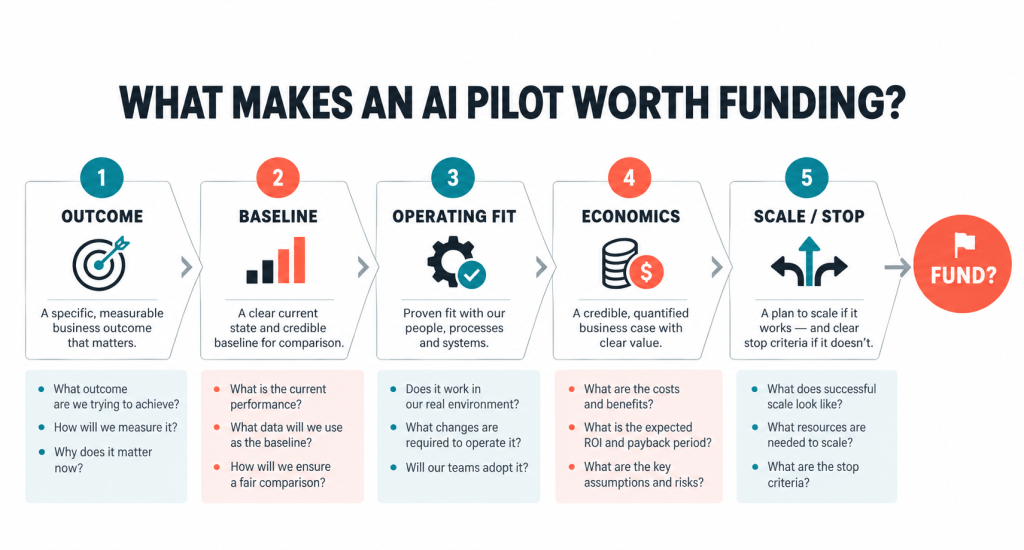
Before approving the next round of funding, test the pilot against five gates.
1. What business outcome will change?
Name the operating outcome, not the AI capability. Is the pilot expected to reduce decision time, increase throughput, lower rework, protect margin, or improve service consistency?
If the outcome cannot be stated clearly, the pilot is still exploring a technology rather than testing an investment.
2. Is there a credible baseline?
Measure the current workflow before interpreting the pilot. Include elapsed time, labor effort, error rates, rework, queue delays, and other material costs.
A percentage improvement means little when the starting point is incomplete or selectively measured.
3. Does it fit the real operating environment?
Test the workflow with actual users, permitted data, required integrations, review points, and representative exceptions.
A pilot should reveal what people, processes, and systems must change. Those requirements are part of the result, not details to address after approval.
4. Do the economics include the whole workflow?
Count implementation, integration, review, monitoring, exception handling, data preparation, and change-management costs.
The business case should show who receives the value, who absorbs the work, and how the benefit will be measured after deployment.
5. Are the scale and stop decisions already defined?
Set thresholds before the results arrive.
What evidence will trigger expansion? What result requires redesign? What adoption, quality, risk, or economic threshold will stop further funding?
A stop decision is not necessarily a failed pilot. Avoiding an unattractive deployment can be one of the pilot’s most valuable outcomes.
Takeaway
The purpose of an AI pilot is not to prove that AI is impressive. That question has become relatively easy to answer.
The purpose is to determine whether a specific organization should invest in a specific AI-enabled workflow under real operating conditions.
Leaders should expect evidence of business outcomes, baseline improvement, workflow fit, complete economics, and clear scale or stop thresholds.
When those elements are present, funding becomes a disciplined investment decision.
When they are absent, the organization is still paying to explore.


Leave a comment