
Problem
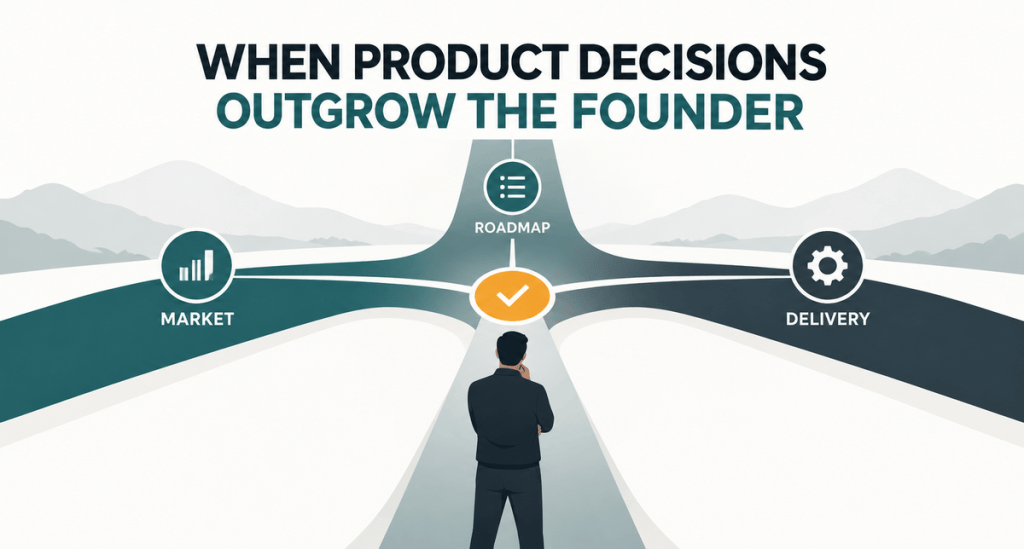
Founder-led product direction can be a strength. Founder-dependent product direction becomes a risk.
A company should not wait for a full-time Chief Product Officer when important product decisions are already stalled, inconsistent, or being made by default.
This often happens during an awkward stage of growth. The company has customers, capable technical people, and a growing list of opportunities. But the CEO is still the final decision-maker for roadmap priorities, customer requests, pricing implications, delivery tradeoffs, and market positioning.
The problem is not that the founder lacks product instincts. The problem is that those instincts have become a dependency.
Decisions wait for the founder. Sales commitments reach engineering before product review. The roadmap reflects the loudest customer rather than the strongest market evidence. Product managers coordinate work but lack the authority to resolve strategic tradeoffs.
At that point, the company has an executive product leadership gap, even if it is not ready to hire a full-time CPO.
Insight
A fractional product executive is not simply a senior product manager working fewer hours.
The role is useful when the company needs executive-level product judgment, cross-functional authority, and operating discipline, but does not yet need—or cannot yet define—the permanent executive position.
The fractional executive should be able to answer questions such as:
- Which market evidence should change the roadmap?
- Which customer requests represent repeatable demand?
- What can sales promise without creating delivery debt?
- Where should product, engineering, sales, and operations make joint decisions?
- What evidence must exist before the company increases product investment?
A consultant may advise on these questions. A fractional executive must help the organization make and operationalize the decisions.
That distinction matters.
A fractional title is not the value. Decision ownership is.
The engagement also needs a defined purpose. A fractional product executive should not become a permanent workaround for unclear leadership. The mandate should build a stronger product operating model, improve decision quality, and clarify what the eventual full-time role must own.
Example
Consider a growth-stage healthtech company with several enterprise customers and a capable product team.
The founder still approved nearly every meaningful roadmap change. Sales had promised customer-specific configurations to help close opportunities, while engineering planned around whichever request appeared most urgent. Security reviews and data-integration dependencies were discovered late because no executive owner was connecting commercial commitments to product and delivery capacity.
The company did not primarily need more backlog management. It needed an accountable product decision process.
A fractional product executive could establish a weekly product council involving the CEO, commercial lead, engineering lead, and product manager. Proposed roadmap changes would require named buyer evidence, an implementation estimate, a decision owner, and an explicit tradeoff against existing commitments.
A shared decision log would record what was approved, rejected, or deferred and why. Roadmap health could then be measured through indicators such as priority changes per quarter, time from customer signal to product decision, and the percentage of committed work connected to a defined buyer or operating outcome.
The immediate value would not be more features. It would be fewer unresolved decisions and less hidden product risk.
Framework
A company should seriously consider a fractional product executive when several of these five signals appear together.
1. The founder has become the product decision queue
Important decisions repeatedly wait for the CEO. Teams can execute, but they cannot resolve priorities without founder intervention. The issue is no longer founder involvement; it is founder dependency.
2. The roadmap contains activity without a clear investment argument
The roadmap is full, but leaders cannot explain which customer evidence, commercial objective, or operating constraint supports each major commitment. Priorities change frequently because there is no shared standard for evaluating them.
3. Commercial commitments are bypassing product decisions
Sales promises features, integrations, or timelines before product and engineering evaluate repeatability, delivery cost, and strategic fit. Customer responsiveness begins creating roadmap debt.
4. Functional leaders are capable, but no one owns the tradeoffs between them
Product, engineering, sales, and operations may each be performing well within their functions. What is missing is an executive owner for the decisions that cross those boundaries.
5. The leadership gap is immediate, but the permanent role is not yet clear
The company may not know whether it ultimately needs a CPO, VP Product, product-oriented COO, or a stronger head of product. Hiring prematurely can lock in the wrong structure. Waiting without leadership allows the decision debt to grow.
A strong fractional mandate should therefore include an exit condition: the operating model is working, the permanent role is defined, and the organization knows which decisions that person must own.
Takeaway
A company does not need a fractional product executive merely because the backlog is busy.
It needs one when product decisions have become material to revenue, delivery, investment, or enterprise credibility—and the current leadership structure cannot make those decisions consistently.
The company does not need part-time thinking. It needs executive-level product leadership at the right stage and for a defined purpose.
The key question is not, “Are we ready to hire a CPO?”
It is, “What is it already costing us to leave product leadership unresolved?”


Leave a comment