
Problem
The largest market is often the most expensive place to learn.
A broad opportunity can hide long sales cycles, fragmented workflows, difficult integrations, and implementation work that never repeats.
Founders frequently ask, “Which market gives us the greatest revenue potential?” That is a sensible question for long-term strategy. It is usually the wrong question for selecting a first market.
The first market has a different job. It must help the company discover:
- Who will fund the product
- Which problem creates urgency
- What evidence supports a buying decision
- How the product fits into an operating workflow
- Which parts of delivery can be repeated
A large market does not guarantee that any of those questions will be answered quickly.
For a technical founder with limited capital, a small team, and an unfinished commercial model, the cost of learning matters as much as the size of the opportunity.
Insight
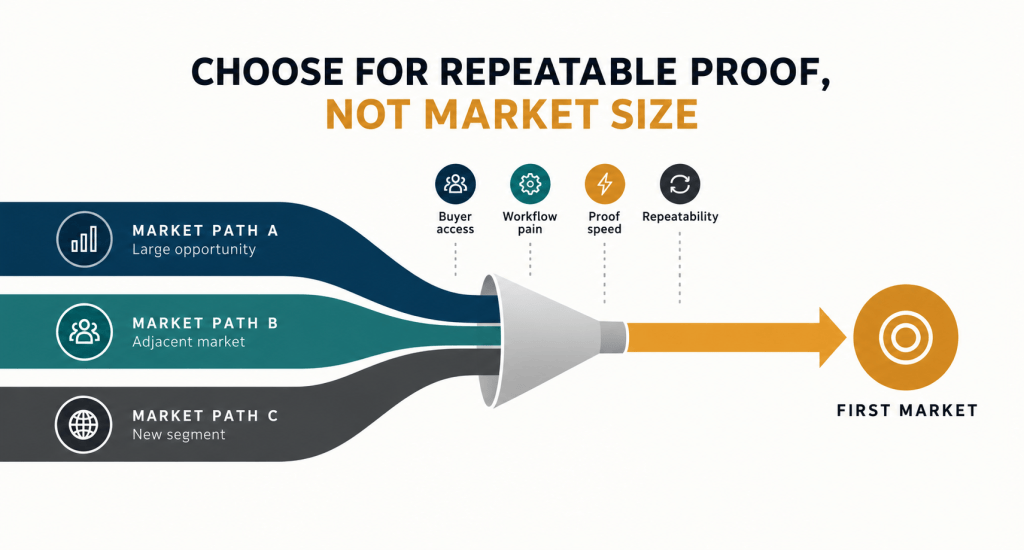
Your first market should be selected for evidence velocity.
That means choosing the market where the company can move most efficiently from technical capability to a funded problem, a workable implementation, a measurable outcome, and a second credible customer.
This does not mean choosing the easiest prospect available. One enthusiastic customer with an unusual requirement can pull the product toward custom development without creating a repeatable market.
It also does not mean ignoring market size. It means sequencing the decision correctly.
The first market needs to be large enough to support a business, but focused enough for the company to learn how the business works.
Your first market is not a prize for ambition. It is a laboratory for repeatability.
The best beachhead is often the market where five things align:
- A costly problem already has an owner.
- The team can reach that owner.
- A buyer can evaluate the product within a practical timeframe.
- Implementation can become more consistent with each customer.
- Success creates a credible path into adjacent accounts or markets.
Example
Consider an early-stage computer-vision company evaluating three possible markets: pharmaceutical packaging, automotive suppliers, and regional food processors.
Pharmaceutical packaging offered attractive contract values, but adoption required extensive validation, multiple approval groups, and a long security and compliance review. Automotive suppliers had clear inspection needs, but each plant used different equipment and integration patterns.
Regional food processors represented a smaller initial market. However, the operating problem was easier to define: packaging defects were causing waste, increasing manual inspection time, and triggering production holds.
The quality leader owned the outcome. Existing camera feeds could support an initial deployment. A paid eight-week proof could be evaluated using agreed measures:
- Manual inspection minutes per production line
- False-reject rate
- Escaped defect count
- Time required to review uncertain images
The operating model was also clear. A plant operations lead owned the deployment. Low-confidence images went to the quality team for review. Production data remained within the plant environment, and the implementation used a standard camera and workflow checklist.
The smaller market offered something the larger markets did not: a faster path to commercial learning.
The team could refine its buyer language, create a repeatable implementation package, establish common success metrics, and determine which exceptions required human review. That evidence could later support expansion into more demanding environments.
The decision was not that food processing was the company’s permanent identity. It was that food processing offered the strongest first learning system.
Framework
Founders can compare candidate markets using five practical tests.
1. Is the pain funded?
Identify the operational consequence, not simply the user complaint.
Who loses time, revenue, capacity, quality, or customer trust when the problem remains unresolved? Does someone already have the responsibility and budget to improve that outcome?
A market full of interested users can still be commercially weak if nobody owns the economic consequence.
2. Can we reach the decision?
A promising market is less useful when every buying conversation depends on an introduction the company cannot repeat.
Assess whether the team can consistently reach the economic buyer, workflow owner, technical evaluator, and any approval functions involved. Founder access to three friendly contacts is not yet a route to market.
3. Can the buyer prove value quickly?
Define the baseline, success metric, required data, review period, and buying decision before starting a pilot.
If every evaluation takes twelve months or depends on an outcome the customer cannot measure, the market may consume more capital than the company can afford.
Fast proof does not mean a superficial demo. It means reaching credible evidence within a commercially sustainable timeframe.
4. Can delivery become repeatable?
Examine the workflow, integration requirements, data boundaries, approval rules, and exception paths.
Some variation is inevitable. The important question is whether each deployment strengthens a common product and implementation model or creates another custom project.
A first market should teach the company how to deliver the second engagement with less uncertainty than the first.
5. Does success create leverage?
Look beyond the first contract.
Will the proof be credible to similar buyers? Can the same package be moved to another account without being rebuilt? Does the market create useful references, channel relationships, data assets, or adjacent use cases?
The first market should create options, not trap the company inside one customer’s requirements.
A simple weighted scorecard can make the tradeoffs visible:
- Pain and urgency: 30%
- Buyer access: 20%
- Proof speed: 20%
- Delivery repeatability: 20%
- Expansion leverage: 10%
The score is not an objective truth. Its value is forcing the leadership team to expose and test its assumptions.
Takeaway
Do not ask only, “Which market could eventually be worth the most?”
Ask, “Which market can teach us how to win, deliver, and win again before we exhaust our time and capital?”
A good first market provides the company with more than just revenue. It produces buyer language, implementation discipline, measurable proof, and a repeatable commercial motion.
That evidence is what earns the right to enter the larger market later.


Leave a comment