
Problem
A product roadmap can be highly detailed and still be unfit for an investment decision.
Dates create the appearance of certainty. They do not prove that the assumptions underneath the plan deserve more capital.
A board may see features assigned to quarters, milestones connected to revenue, and customer commitments shown on a timeline. What it often cannot see is what must be true for that plan to work.
Will the customer adopt the new workflow?
Can the team deliver it with its current capacity?
Are critical integrations controlled by someone else?
Will the expected adoption produce the projected economics?
When those assumptions remain hidden, the roadmap communicates more confidence than the evidence supports.
Insight
A roadmap is an investment thesis expressed through product decisions.
Every major initiative represents a belief about customers, adoption, delivery capacity, dependencies, and economic value. Yet many roadmaps present those beliefs as settled commitments.
That makes it difficult for boards and investors to distinguish among three very different things:
- What the company knows
- What management currently believes
- What the company still needs to prove
Investors do not expect leaders to eliminate uncertainty. They expect leaders to understand it, test it, and allocate capital accordingly.
Visible assumptions do not weaken a roadmap. They demonstrate management control.
A credible roadmap should therefore show more than what the team plans to build. It should also show why the initiative deserves investment, what evidence supports it, what could prevent success, and what management will do if the evidence changes.
Example
Consider an anonymized pattern from a B2B workflow platform preparing its growth plan for a board review.
The roadmap showed three major initiatives over two quarters: enterprise administration, single sign-on, and automated reporting. Each initiative had a target delivery date and an associated revenue opportunity.
The plan looked precise. The underlying assumptions were less mature.
Only two design partners had validated the administration workflow. The adoption forecast assumed customer operations teams would migrate without additional implementation support. Almost 30% of engineering capacity was already being consumed by customer-specific integration work. The single sign-on milestone depended on an external identity provider and a customer security review that the product did not control.
The problem was not that the initiatives were necessarily wrong. The problem was that the roadmap gave the board no way to evaluate the confidence behind them.
The team restructured the plan around evidence gates.
Enterprise administration would move from validation to full development only after additional buyers confirmed the same decision rights and approval workflow. The adoption plan received a named operations owner and a usage threshold. Implementation effort became a tracked economic variable. The identity integration received a dependency owner, an escalation path, and a separate confidence rating.
The roadmap still contained dates. But the investment conversation changed from “Will this ship in the second quarter?” to “What evidence will justify the next stage of investment?”
That is a much stronger product-management discussion.
Framework
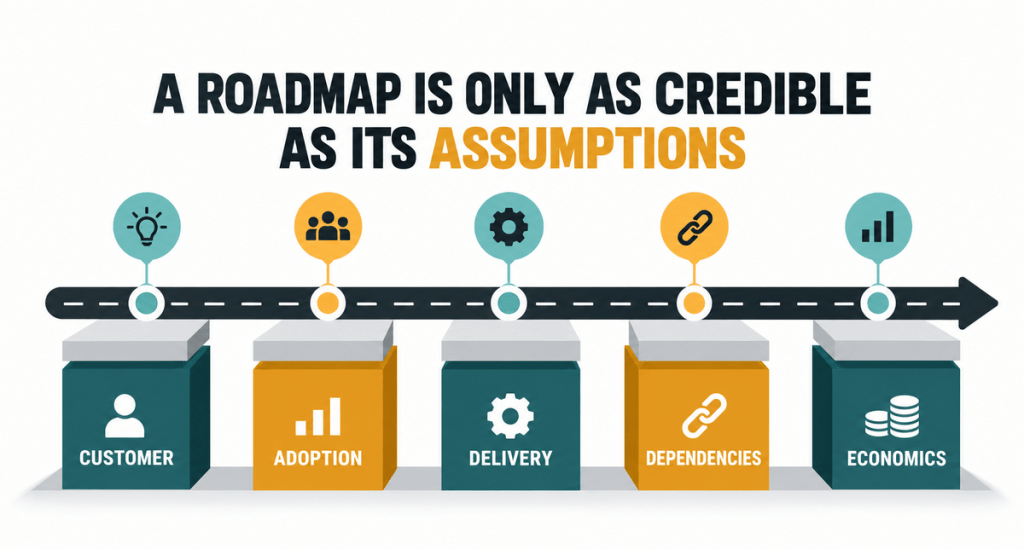
Before approving a major roadmap investment, test five assumptions.
1. Customer assumption
What evidence shows that a sufficiently important customer problem exists?
Separate repeated market evidence from one influential request. Identify the buyer, the affected workflow, and the consequence of leaving the problem unresolved.
2. Adoption assumption
What must users change for the product to create value?
Define the required behaviour, the workflow owner, the implementation effort, and the adoption threshold. Shipping a capability is not the same as securing its use.
3. Delivery assumption
Does the team have the capacity and capability to deliver the promised outcome?
Include customer-specific work, technical remediation, data preparation, review requirements, and operational handoffs. Roadmaps become misleading when only feature-development effort is visible.
4. Dependency assumption
Which parts of the outcome depend on another team, vendor, partner, customer, or approval process?
Name the dependency owner, decision deadline, fallback path, and effect of a delay. A date controlled by someone else should not be presented as an unconditional commitment.
5. Economic assumption
What evidence connects the initiative to retention, expansion, margin, risk reduction, or another meaningful business outcome?
Define the expected unit of value and the evidence required before funding the next stage. Revenue shown beside a roadmap item is not proof that the item will produce it.
Each assumption should have an owner, current evidence, confidence level, review date, and management response if it proves false.
Takeaway
Boards should not ask product leaders to manufacture certainty. They should ask them to manage uncertainty with discipline.
A credible roadmap makes the logic behind capital allocation inspectable. It shows which commitments are supported, which hypotheses are being tested, and which dependencies could change the plan.
Precision is not readiness. Managed uncertainty is.
The strongest roadmap is not the one with the most confident dates. It is the one that helps leaders make better investment decisions as the evidence changes.


Leave a comment