
Problem
Selling faster can make growth less credible.
If implementation capacity cannot absorb new bookings, a higher sales target creates delayed go-lives, margin leakage, and frustrated customers rather than scalable revenue.
Boards routinely review pipeline coverage, win rates, and annual recurring revenue. They are less likely to see whether the organization can implement what sales expects to close.
That omission matters. A contract is an important commercial milestone, but it is not yet an operating outcome. The customer still needs to integrate the product, configure the workflow, prepare its data, train its people, and reach meaningful use.
When those steps depend on a small group of specialists or a different delivery plan for every customer, sales growth can expose an operating constraint that the forecast never showed.
Insight
Implementation is not an activity that happens after revenue. It is part of the revenue system.
For enterprise software, healthtech, AI platforms, and other technically complex offerings, implementation capacity influences:
- when contracted revenue becomes usable revenue
- how quickly customers reach value
- whether gross-margin assumptions hold
- how much product and engineering capacity is diverted
- whether renewals and expansions remain credible
The board does not need to manage implementation. It does need to understand the assumptions connecting bookings to adoption and retention.
This requires more than a headcount plan.
True capacity depends on how standardized the offer is, which integrations are supported, how ready customers must be, where expert review is required, and how exceptions are handled. Adding another project manager will not solve a capacity problem caused by undefined configuration boundaries or founder-dependent decisions.
A target is not credible because demand exists. It is credible when the operating system can absorb the demand.
Example
Consider a common pattern in an enterprise workflow software company.
The pipeline supported an aggressive growth target, and fourteen customer launches were already contracted across the next two quarters. The revenue plan assumed that most customers could go live within six weeks.
The operating evidence told a different story.
The median implementation was taking eleven weeks. Two integration leads were supporting every deployment. Four customers had not completed their data mappings, security reviews were following three different paths, and a senior architect was still approving configuration decisions that had never been converted into product rules.
The backlog looked like commercial momentum. In practice, it contained several different kinds of work with different readiness levels and delivery demands.
Leadership introduced five changes:
- Customers had to pass a data and ownership readiness gate before receiving a confirmed implementation slot.
- Concurrent implementations were capped based on integration capacity, not contract count.
- One standard integration path became the default, with deviations requiring an explicit scope and margin decision.
- The COO owned exceptions that could affect launch dates or delivery economics.
- Forecasting began distinguishing contracted backlog from readiness-adjusted launch capacity.
The management team also added time to go-live, implementation hours per customer, milestone slippage, early adoption, and delivery margin to its operating review.
The purpose was not to suppress sales. It was to make the growth plan investable, deliverable, and easier to defend.
Framework
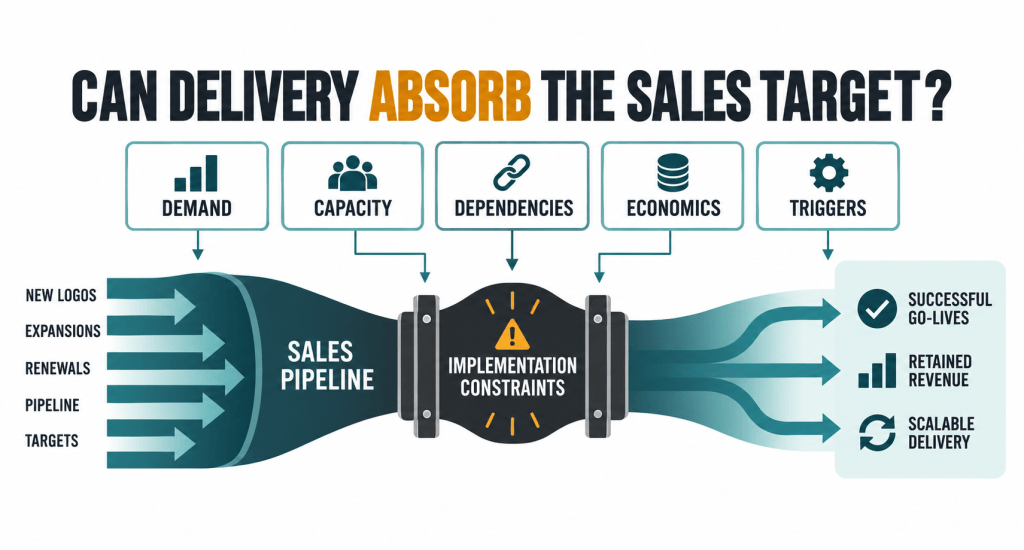
Before approving a larger sales target, boards should test five areas.
1. Demand: What exactly is expected to close?
Separate new logos, expansions, renewals, and customer segments. Each may create a different implementation burden. A revenue target without a delivery mix is incomplete.
2. Capacity: What determines actual throughput?
Measure the number of customers that can reach meaningful use, not simply the number that can be assigned a project manager. Identify scarce roles, approval points, and specialist dependencies.
3. Dependencies: What must be true before delivery can begin?
Define customer data requirements, integration readiness, security approvals, internal ownership, and required third-party participation. A signed customer is not necessarily a ready customer.
4. Economics: Does each implementation support the business model?
Track implementation hours, external costs, product and engineering interruptions, exception work, and margin by customer type. Unpriced delivery complexity can make revenue growth look healthier than it is.
5. Triggers: When should the company invest, constrain, or redesign?
Agree on thresholds for hiring, partner capacity, implementation caps, pricing changes, and productization. These decisions should be triggered by evidence before missed launches force a reaction.
Takeaway
Boards should not respond to an implementation constraint by automatically lowering the sales ambition.
They should make the operating assumptions behind that ambition visible.
A credible growth plan connects demand, delivery capacity, customer readiness, economics, and investment triggers. Without that connection, the company may hit its bookings target while weakening customer outcomes and future revenue quality.
The board-level question is not simply, “Can we sell more?”
It is, “Can we turn what we sell into repeatable customer value?”


Leave a Reply