
Problem
Enterprise buyers often talk about price when they are uncertain about the decision.
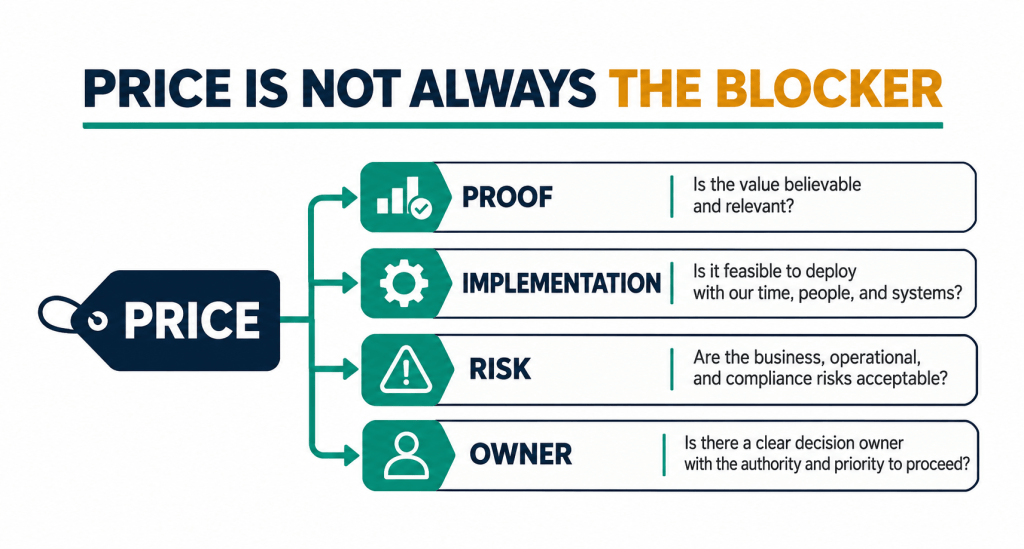
Technical founders hear “the budget is too high” and reach for a discount. But a lower price does not resolve weak proof, unclear implementation ownership, security concerns, or uncertainty about who will defend the purchase internally.
The fastest concession is often the most expensive diagnosis.
This matters because discounting does more than reduce revenue. It can conceal the reason an opportunity is actually stalled. The founder gives away margin, the buyer still cannot proceed, and both sides spend another month discussing commercial terms around an unresolved operating problem.
Price is sometimes the blocker. It is rarely the only possibility.
Insight
Enterprise objections tend to get compressed into language that is easy to communicate:
- “We do not have the budget.”
- “The timing is difficult.”
- “We need a stronger business case.”
- “Procurement wants a lower number.”
Each statement may be accurate. None necessarily identifies the decision that is preventing the purchase.
A buyer may believe the product has value but lack credible evidence for its environment. The sponsor may want to proceed but have no implementation owner. Procurement may challenge the price because the proposed scope contains too much uncertainty. Finance may see projected benefits but no defensible baseline.
In those situations, a discount makes the offer cheaper without making the decision safer.
A true price objection usually appears after the buyer understands the value, accepts the proof, can see the implementation path, has bounded the risk, and has someone prepared to own the outcome. When those conditions are absent, price often becomes a proxy for unresolved adoption risk.
Example
Consider an anonymized pattern involving a healthcare analytics company selling to a provider organization.
The operating team liked the product and the executive sponsor saw a plausible use case. During commercial discussions, however, the buyer said the proposal exceeded the available budget. The vendor began preparing a substantial discount.
A closer review showed that price was only the visible objection.
Security had not approved the proposed data flow. The initial deployment required an export controlled by an IT team that had not been included in planning. The executive sponsor owned the business relationship, but nobody had accepted responsibility for implementation. Finance had also received projected efficiency gains without a baseline for current manual review time.
Reducing the price would not have solved any of those issues.
The commercial conversation changed when the team:
- limited the first phase to an approved data boundary;
- added a security review checkpoint before deployment;
- named an IT owner for the data handoff;
- established current review hours as the value baseline; and
- separated the initial validation from the larger rollout decision.
Price remained part of the discussion, but it became a real economic decision instead of a proxy for uncertainty.
That distinction protects both margin and buyer trust.
Framework
Before changing the price, ask five questions.
1. Is the value specific enough?
What measurable operating or commercial outcome will change? A broad claim about efficiency is difficult to fund. A defined reduction in review time, implementation effort, error exposure, or lost revenue gives the buyer something concrete to evaluate.
2. Does the proof match this buyer’s decision?
A case study may show that the technology works. The buyer still needs evidence that it can work with their data, workflow, risk profile, and users. Define the proof threshold before offering a concession.
3. Is the first implementation step owned?
Who provides the data? Who approves access? Who configures the workflow? Who reviews early results? A purchase can stall because the buyer sees an internal project without an owner.
4. Is the risk bounded clearly enough?
Security, compliance, integration, change management, and operational continuity can all surface as commercial hesitation. Clarify the data boundary, approval rules, exception path, and rollout scope so the buyer can defend the decision.
5. If the first four conditions are satisfied, does the price still fail the economics?
Now the team can assess a genuine price issue. If a concession is warranted, connect it to a commercial commitment such as narrower scope, a longer term, defined volume, faster approval, or a reference agreement.
A discount should buy a commercial commitment, not compensate for unresolved operating risk.
Takeaway
Founders should not defend every price or refuse every discount. They should diagnose the objection before changing the economics.
When an enterprise opportunity slows down, ask which decision the buyer still cannot make. Is the value unclear? Is the evidence weak? Is implementation unowned? Is the risk too open-ended? Or does the price genuinely fail the business case?
The answer determines whether the offer needs a lower number, stronger proof, a smaller first step, or a clearer operating plan.
Commercial discipline begins when the team stops treating every objection as a negotiation.


Leave a Reply