
Problem
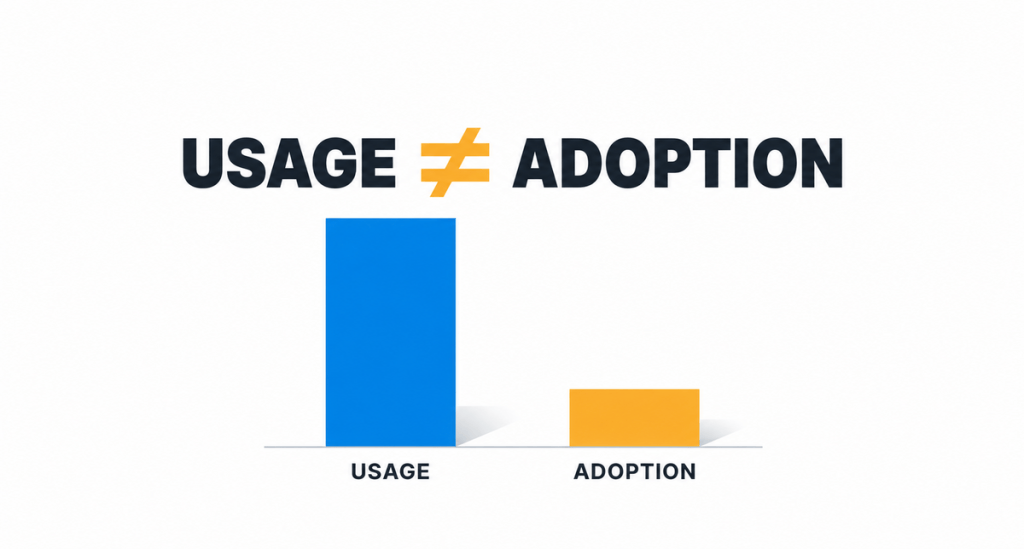
AI usage can rise while operational adoption remains flat.
A team can generate hundreds of prompts, attend training, and use an AI assistant every week while continuing to make important decisions exactly as it did before.
That is not necessarily adoption. It may simply be activity surrounding an unchanged workflow.
Many leadership dashboards emphasize what is easiest to count: activated licenses, weekly users, submitted prompts, or completed training. Those measures confirm that people have access to the technology. They do not show whether employees trust the output, use it in consequential work, or achieve a better operating result.
This creates a commercial and management risk. An AI program can appear successful while duplicate work, manual verification, and slow decisions continue underneath the activity metrics.
Insight
Operational adoption begins when AI changes what happens next in a real workflow.
That means the output is accepted under defined conditions, influences a decision, and produces a measurable improvement without creating unacceptable risk or rework.
Usage tells you the tool was opened. Adoption tells you the work changed.
That distinction matters because high usage can have several explanations. Employees may be experimenting. They may be using the tool for low-consequence tasks. They may also generate an answer and then manually recreate the work because they do not trust it.
In that last case, greater usage can actually mean more work.
Leaders need to distinguish three stages:
- Experimentation: People test what the tool can do.
- Assistance: The tool helps produce an intermediate output.
- Operational reliance: The output advances a defined workflow under agreed rules.
Only the third stage represents durable operating-model change.
Example
Consider a research organization introducing AI-assisted literature triage.
The system searched an approved collection of journal articles and ranked potentially relevant papers. Weekly usage looked strong. Analysts regularly ran searches, adjusted queries, and reviewed the generated lists.
But the downstream workflow had barely changed.
Analysts exported the results into spreadsheets and manually re-screened nearly every paper. There was no shared acceptance threshold for an AI-ranked result, no structured reason code for rejecting one, and no method for determining whether the system had missed important evidence.
Scientists remained responsible for final inclusion decisions, but the handoff between the analyst, the AI output, and the scientific reviewer was undefined. The system had become an additional step in the research process rather than a dependable part of the workflow.
The organization redesigned the process around a few operating decisions:
- The source boundary remained limited to approved publications; unpublished and restricted research stayed outside the system.
- Analysts used defined relevance criteria rather than relying solely on individual judgment.
- Low-confidence and conflicting results moved to a named scientific reviewer.
- Overrides captured a reason that could inform future evaluation.
- The team measured first-pass acceptance, review cycle time, and the number of relevant papers missed.
The goal was not to maximize searches. It was to reduce avoidable screening work without weakening research quality.
That changed the meaning of adoption. Activity remained useful, but it became an early signal rather than the result itself.
Framework
Leaders can assess AI adoption using a five-level evidence ladder.
1. Access: Can the intended users use it?
Confirm that the right roles have access, training, approved data boundaries, and a defined use case. This is deployment evidence, not adoption evidence.
2. Use: Is it being used for the intended job?
Measure whether the tool appears inside the target workflow, not merely whether someone opens it. Separate production use from experimentation and incidental tasks.
3. Acceptance: Does the output move forward?
Track how often users accept, materially rewrite, reject, or recreate the output. Repeated manual reconstruction is a stronger signal than a high prompt count.
4. Decision: Does it influence a consequential action?
Name the decision the output supports, the person who retains authority, and the conditions requiring escalation. If the output never affects a decision, the workflow has not materially changed.
5. Outcome: Is the workflow performing better?
Compare results with a baseline. Relevant measures may include cycle time, rework, cost per completed case, error rates, exception volume, or decision quality.
Do not jump from level two to an ROI claim.
A high number of active users can justify further investigation. It cannot, by itself, demonstrate operating value.
Takeaway
Executives do not need another adoption score based on simple activity metrics. They need evidence that AI is responsibly changing a defined workflow and producing better results.
Start with one consequential workflow. Trace the path from access to use, acceptance, decision, and outcome. Look for duplicate work, hidden verification, and outputs that never influence what happens next.
The question is not, “How many people are using AI?”
The better question is, “Where has AI become dependable enough to change how the work gets done?”


Leave a Reply