
Problem
A design partner can love the product and still mislead the company.
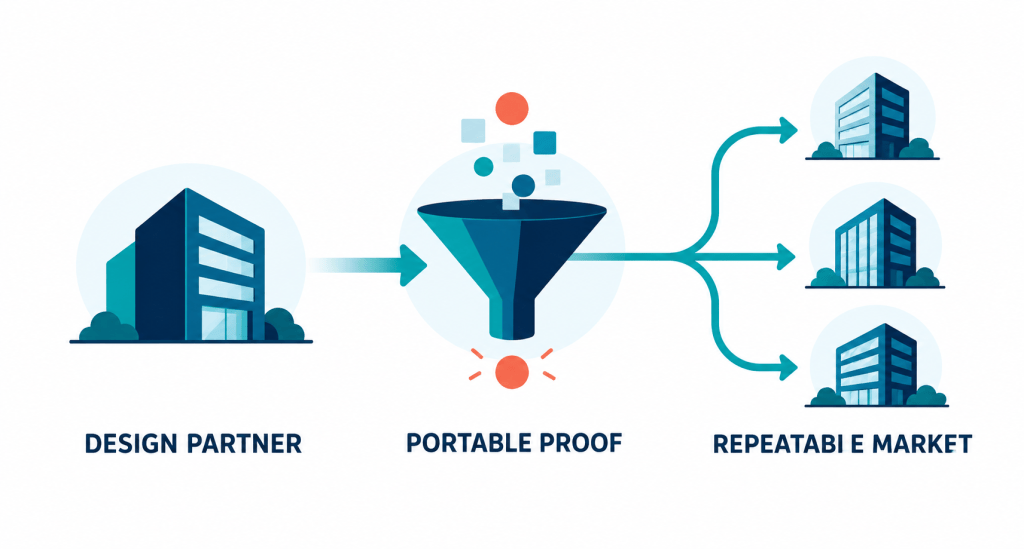
One successful relationship is customer evidence. It is not yet market evidence.
The commercial risk appears when founders treat deep collaboration, enthusiastic feedback, and a working implementation as proof that they have found a repeatable market.
Design partners are unusually willing to help. They explain their workflows, tolerate product gaps, provide internal context, and work around rough edges. That makes them valuable learning partners.
It can also hide how much of the success depends on that particular relationship.
The customer may be supplying clean data, internal expertise, executive sponsorship, or implementation support that another buyer will not provide. The founder may be personally resolving every exception. The product team may be building customer-specific logic without pricing or separately tracking it.
From inside the relationship, this can feel like product-market fit.
From outside it, the next buyer may see an unfinished commercial offer.
Insight
A design partner should help a company discover what is repeatable, not become the definition of the product.
That requires founders to separate three things:
- The underlying problem that exists across the market
- The product capability that solves it consistently
- The accommodations that make one customer successful
These categories often become blurred because early companies are rewarded for responsiveness. The team wants the partnership to work, so it closes every gap manually.
But responsiveness becomes dangerous when customer-specific work is mistaken for product progress.
Your first customer can prove the product works inside their organization. The next customer proves whether you built a business.
The commercial objective is not to eliminate customization. Enterprise products will always require some configuration, integration, and operating alignment.
The objective is to know which elements can vary without changing the product’s core economics, implementation burden, or value proposition.
Example
Consider a healthtech company developing a workflow platform to classify and route clinical documents.
Its design partner provided scheduled data exports, accepted a custom classification taxonomy, and assigned a vice president of clinical operations to review the exception queue weekly. Success was measured by reduced manual sorting and faster assignment to the correct team.
The implementation worked, and users responded positively.
Then the company entered discussions with a second provider.
That buyer did not have the same export format. Its privacy team restricted several data fields used in the original classification rules. Its operations leader expected implementation to proceed without the founder attending every workflow meeting.
The team realized that parts of its apparent product success depended on customer-specific mappings, analyst cleanup, and decisions that were still made by the founder.
The design partnership had produced valuable learning, but not all of that learning was commercially portable.
The company began separating the repeatable offer from the original accommodation. It defined a supported data contract, made terminology configurable within clear limits, documented who owned implementation decisions, standardized the exception queue, and created a consistent set of adoption and workflow metrics.
Customer-specific work did not disappear. It became visible, bounded, and priced separately.
That distinction changed the commercial conversation. The company could explain what the product did, what the customer needed to provide, and where additional services would begin.
Framework
Before treating a design partner as evidence of a beachhead market, ask five questions.
1. Does the problem repeat?
Can several similar buyers describe the same urgent workflow problem without being led toward your solution?
A recurring problem is stronger evidence than recurring interest in the technology.
2. What is product and what is accommodation?
Identify every custom data transformation, manual intervention, founder decision, and customer-specific rule supporting the implementation.
Decide which elements belong in the product, which should become configurable, and which should remain paid services.
3. Does the evidence support another buyer’s decision?
Positive feedback is useful, but another buyer may need evidence about implementation effort, review requirements, operating impact, security boundaries, or economic value.
Build proof around the next buying decision, not only the first customer’s satisfaction.
4. Do the economics survive repetition?
Calculate the implementation hours, specialist involvement, support load, and exception-handling effort required to deliver the outcome.
Revenue is not repeatable when every new customer requires an unpriced consulting project.
5. Can the learning transfer without the founder?
Ask whether a product, sales, or implementation leader could take the offer to the next customer using documented boundaries, proof, and decision rules.
If the founder must reinterpret the product for every buyer, then the learning has not yet travelled.
Takeaway
Design partners can accelerate customer discovery, product learning, and commercial credibility. They become dangerous only when proximity is confused with repeatability.
Do not ask only whether the design partner is successful.
Ask what another buyer would need to achieve the same outcome, what would have to change, and whether the business can deliver it with predictable effort and economics.
A design partner earns strategic value when the learning becomes portable.
That is the point where a productive relationship starts becoming a market.


Leave a Reply