
Problem
A board deck can make the growth story look sharper. It cannot make weak evidence more investable.
When investors, acquirers, strategic partners, or board members press into the details, they are not only testing ambition. They are testing whether the company can explain how growth repeats, where risk lives, and which operating assumptions have already been proven.
That is where many leadership teams find the gap.
The story says the company is ready to scale. The evidence says the company is still relying on custom effort, informal decisions, founder judgment, and inconsistent proof from one customer or pilot to the next.
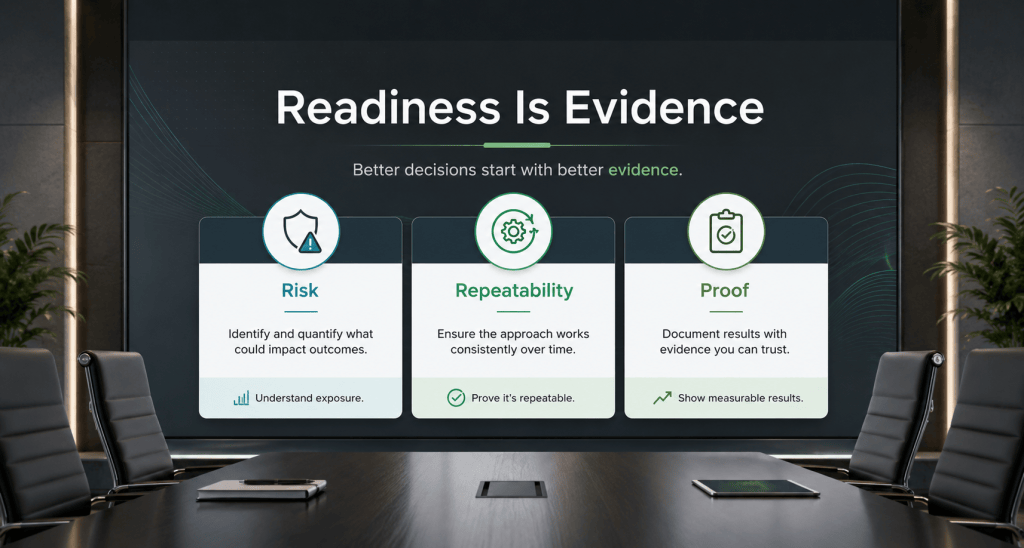
This matters because board and investor readiness is not a presentation exercise. It is an evidence exercise.
A stronger narrative may get attention. Diligence-ready evidence builds confidence.
Insight
Boards and investors usually do not expect perfection. They do expect clarity.
They want to know which assumptions are proven, which are still being tested, and which risks have an owner. They want to see whether the company understands its own operating model well enough to repeat it.
That does not mean every process must be mature. Early and growth-stage companies are still learning. But the learning has to be visible.
For example:
- Which buyer segment is producing the strongest signal?
- Which implementation steps are repeatable?
- Which risks are being actively governed?
- Which metrics actually show traction?
- Which exceptions still require senior leadership judgment?
The issue is rarely that the company lacks activity. The issue is that the activity has not been converted into evidence.
A board deck can describe momentum. A diligence packet has to prove what momentum is made of.
That distinction changes the work. Instead of asking, “How do we tell the story better?” leadership should ask, “What would a serious reviewer need to test this story?”
Example
Consider a healthcare workflow technology company preparing for investor and strategic partner conversations.
The company had a credible product, several promising pilots, and strong executive interest. The board deck described a large market, an enterprise-ready platform, and a strong expansion path.
But when the team looked at the evidence behind the story, several problems appeared.
Pilot results were not measured consistently. One customer emphasized time saved, another emphasized quality review, and another cared most about turnaround time. All were valid signals, but they did not add up to a clean repeatability story.
Data access approvals were being handled case by case. The product team knew the boundaries, but they were not written in a way a partner or investor could easily inspect.
Exception handling was also unclear. When the workflow produced an edge case, the decision often went back to a senior operator or founder. That worked in early pilots, but it raised a scale question: who owns exceptions when there are ten implementations instead of two?
The team did not need to exaggerate the story. They needed to make the evidence easier to test.
They rebuilt the readiness materials around a smaller set of proof points:
- a defined target buyer and workflow owner
- a consistent pilot success metric
- a documented data access rule
- a named exception owner
- a simple implementation path showing what had repeated across accounts
That changed the board conversation.
Instead of reviewing a broad growth claim, the board could inspect the assumptions behind it. Instead of asking whether the company was “ready,” they could ask which part of readiness had evidence and which part still needed work.
That is a more useful conversation.
Framework
Before an investor meeting, board review, acquisition discussion, or strategic partnership conversation, leadership teams should pressure-test five questions.
- What claim are we asking the market to believe?
Every readiness discussion contains claims. We can scale. We can sell into this market. We can implement repeatedly. We can manage risk. We can expand from one use case into several.
Name the claim clearly before building the evidence around it.
- What evidence proves the claim?
Evidence should be inspectable. Customer anecdotes help, but they are not enough by themselves.
Useful evidence may include repeatable sales steps, pilot conversion data, implementation timelines, usage patterns, margin assumptions, customer references, governance artifacts, security review readiness, or documented workflow outcomes.
The evidence should reduce uncertainty around a business decision.
- Who owns the evidence?
If no one owns the evidence, it usually becomes scattered across sales notes, product documents, board slides, finance models, and founder memory.
That creates diligence friction.
Assign ownership. Sales may own pipeline quality. Product may own workflow proof. Finance may own unit economics. Operations may own implementation repeatability. Leadership owns the narrative that connects them.
- What will break under serious review?
This is the uncomfortable question, and it is often the most valuable one.
Maybe the market story is too broad. Maybe pricing logic is still anecdotal. Maybe implementation depends on one expert. Maybe risk controls exist in practice but not in documentation. Maybe the company has traction, but not yet evidence of repeatability.
Finding these gaps internally is far better than having an investor, partner, or board member discover them first.
- What decision should this evidence support?
Evidence is not collected for decoration. It should support a decision.
A board may need to decide whether to fund expansion. An investor may need to decide whether the company is ready for capital. A partner may need to decide whether integration risk is manageable. An acquirer may need to decide whether growth can continue after the founder steps back.
If the evidence does not support a decision, it is probably noise.
Takeaway
Board and investor readiness is not about making the company look more mature than it is.
It is about making the current maturity level clear, credible, and testable.
That requires discipline. Leaders need to separate narrative from evidence, ambition from proof, and activity from repeatability.
The strongest readiness work often feels practical rather than dramatic:
- define the claim
- organize the proof
- name the risks
- show the operating model
- clarify what still needs to be proven
A better board deck may help people understand the story.
But diligence-ready evidence helps them believe the story can survive contact with reality.


Leave a comment