
Problem
The Canada-U.S. trade conflict started with physical goods. It is becoming a contest over the infrastructure that determines who creates the next generation of economic value.
On August 22, the United States imposed 50% tariffs on C$27.6 billion of Canadian goods. Canada has announced matching countermeasures on C$27.6 billion of U.S. imports effective September 8, with electronics among the sectors affected. Department of Finance Canada
Retaliation may protect exposed industries and create negotiating leverage. But tariffs alone will not solve Canada’s deeper vulnerability: lower productivity, concentrated export markets, and dependence on foreign-controlled technology infrastructure.
Canada cannot tariff its way to AI sovereignty. It has to commercialize it.
That is the more consequential leadership challenge for Canadian founders, CEOs, boards, policymakers, and industrial operators.
Insight
AI affects the trade conflict through five connected economic levers.
First, AI is becoming a productivity weapon.
Tariffs raise the cost of producing and selling goods. AI can partially offset that pressure by improving engineering, production scheduling, inventory management, logistics, quality control, and administrative work.
The Bank of Canada now includes broader AI adoption as a source of future productivity growth in its outlook. Bank of Canada
AI cannot make a 50% tariff disappear. But if a manufacturer can reduce rework, shorten engineering cycles, carry less inventory, or serve customers with fewer administrative handoffs, it changes the economics around that tariff.
Second, technology infrastructure is becoming a matter of sovereignty.
Canada’s national AI strategy describes domestic compute, cloud, connectivity, data, and talent as foundations of national sovereignty. It also acknowledges that Canada’s current AI data-centre and cloud offerings are largely foreign-owned and controlled. Canada’s National AI Strategy
The procurement question is therefore changing from:
“What is the cheapest cloud option?”
to:
“Who controls the infrastructure, where does the data reside, and what happens if access becomes politically constrained?”
Third, procurement is becoming industrial policy.
The federal Build-Partner-Buy approach directs government to build with Canadian firms where domestic capability exists, partner with trusted allies where it does not, and buy from abroad after those options have been considered. Government procurement is also intended to make the public sector an anchor customer for Canadian AI companies. Prime Minister of Canada
That can redirect significant technology spending without placing a conventional tariff on an American cloud or AI service.
Fourth, energy is becoming part of AI commercialization.
Canada’s AI strategy estimates that commercial players could require approximately 5.5 GW of AI compute by 2030. Current sovereign infrastructure proposals could provide 850 MW and scale to 2.3 GW.
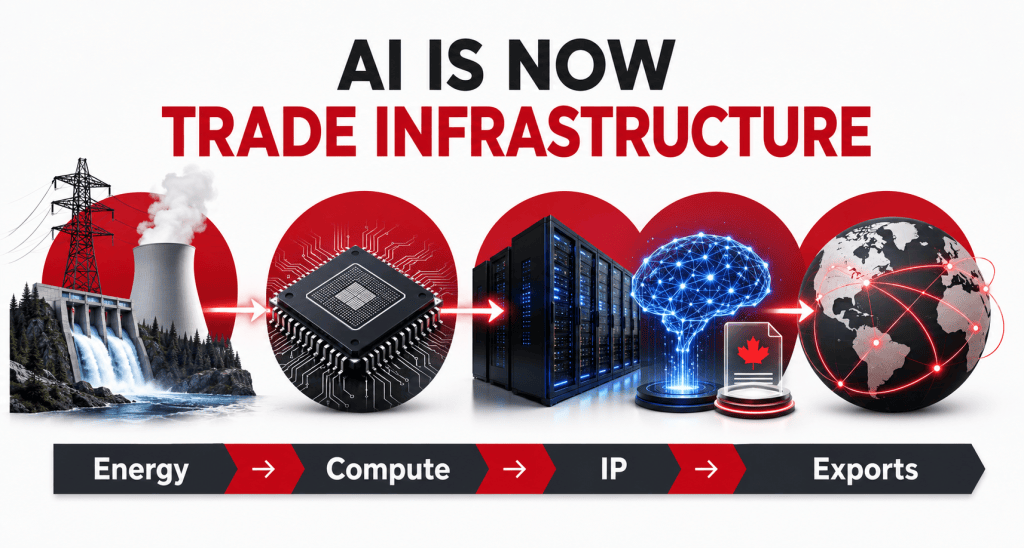
Canada has low-carbon electricity, favourable geography, connectivity, research talent, and institutional stability. The commercial question is whether those advantages will primarily enable the development of foreign-owned infrastructure or the creation of Canadian-controlled intellectual property and exportable services.
Sovereignty without commercialization is expensive capacity.
Fifth, AI can help Canadian companies diversify beyond the United States.
Localization, translation, compliance analysis, customer support, sales development, and software delivery can all become easier to scale across multiple markets. That matters because Canada’s strongest long-term response to trade pressure may be reducing its dependence on any single export market.
Example
Consider a common pattern for a Canadian industrial technology company.
The company sells into both Canadian and U.S. manufacturing operations. Its hardware inputs have become more expensive, its U.S. sales economics are under pressure, and every new market requires substantial implementation support.
The first instinct might be to automate everything or move infrastructure to the lowest-cost provider.
A better commercialization decision would be narrower.
The company could use AI to improve production scheduling and detect quality exceptions before shipment. Customer data could remain within a Canadian-controlled environment. A plant operations manager would own the review decision, and any low-confidence recommendation would enter a defined exception queue rather than automatically changing the production schedule.
The commercial metric would not be “number of AI recommendations.” It would be cost per completed production order, inventory days, rework rate, and manager review time.
The same operating package could then be localized for European or Asian customers without rebuilding the product and support model for every market.
That approach connects productivity, data control, workflow accountability, and export readiness. It makes AI part of the company’s commercial architecture rather than an isolated technology project.
Framework
Leaders evaluating AI in the context of trade exposure should apply five commercialization tests:
1. Productivity: Which tariff-exposed cost can AI actually change?
Name the workflow, baseline cost, operating owner, and measurable outcome. “Using AI” is not an economic strategy.
2. Control: Which dependencies could become points of leverage?
Map chips, cloud services, models, data locations, software components, and operating access. Decide which dependencies must be Canadian-controlled and which can be managed through trusted partners.
3. Procurement: Can public demand create a repeatable commercial product?
Government should be an anchor customer, not the only customer. Canadian firms need offers that can survive competitive buying processes and expand into other sectors and markets.
4. Energy: Where will the value created by Canadian electricity ultimately sit?
A data centre creates investment and employment. A broader ecosystem that produces models, applications, intellectual property, and exports captures more durable value.
5. Markets: Does AI make the company less dependent on one geography?
Use AI to reduce the cost of entering, supporting, and complying with multiple markets. Diversification should be designed into the operating model, not added after another trade disruption.
Takeaway
The Canada-U.S. trade conflict is no longer only about steel, aluminum, autos, lumber, or electronics.
The next layer is:
chips → electricity → data centres → cloud → models → data → intellectual property
Who controls those layers influences where productivity gains, corporate profits, strategic leverage, and export value accumulate.
Canada is moving to build sovereign compute, including a public supercomputer and Canadian-based infrastructure initiatives. Work with domestic providers such as TELUS is also advancing, although the government notes that no funding had yet been committed to that proposed project as of May. Innovation, Science and Economic Development Canada
Those are important foundations. They are not the final outcome.
The real test is whether Canadian companies can turn research, energy, compute, procurement, and trusted operating models into products that customers can buy repeatedly at home and abroad.
AI is not simply another sector affected by the trade war. It may be one of the tools Canada can use to reduce the vulnerability the trade war has exposed.


Leave a comment