
Problem
The most impressive AI use case is often the wrong place to start.
If leaders choose based on demo appeal, they inherit workflow risk they have not designed for.
This is where many AI initiatives begin to drift. A team sees a powerful capability, imagines a broad business impact, and starts with the use case that sounds most visible. Customer service automation. Sales enablement. Clinical documentation. Claims review. Executive reporting. The demo is persuasive because the output looks useful.
But adoption does not happen inside the demo.
Adoption happens inside the workflow, where data is incomplete, exceptions are frequent, review ownership is unclear, and people need to understand when to trust the output and when to slow down.
The problem is not ambition. The problem is selection discipline.
Leaders often ask, “Where can AI have the biggest impact?” That is a good strategic question, but it is not always the best starting question. Early adoption should also ask, “Where can we responsibly operate this, measure it, review it, and improve it without creating unmanaged risk?”
AI scale starts with operating fit.
Insight
A good AI use case is not just a task that AI can perform.
It is a workflow where the organization can define the boundaries around the task.
That distinction matters. AI may be technically capable of summarizing documents, triaging requests, drafting responses, detecting patterns, or supporting decisions. But the business still has to decide where the tool enters the workflow, what information it can use, who reviews the output, what happens when confidence is low, and how value will be measured.
The best first use case is usually not the flashiest one. It is the one with enough value to matter and enough structure to govern.
That is especially true in healthcare, insurance, research, financial services, and other compliance-sensitive environments. The bar is not only whether AI can produce a useful answer. The bar is whether the organization can use that answer repeatedly, responsibly, and with enough confidence to change how work gets done.
The wrong starting use case creates noise. The right starting use case creates operating learning.
Example
Consider a common pattern inside an insurer or healthcare services organization.
The leadership team wants to use AI to improve customer or member service. The broad idea is appealing: faster responses, less administrative load, better access to information, and a more consistent experience.
The first instinct may be to apply AI directly to front-line customer interactions. That sounds high impact. It also brings immediate operating questions: what information can the tool see, what advice is it allowed to provide, when must a human step in, what language creates compliance risk, and who is accountable if the response affects a member decision?
Instead of starting there, the better first use case may be narrower: an internal appeal-summary workflow.
In that workflow, AI helps summarize documents for an internal team before a human reviewer makes a decision. The data boundary is defined: only approved case documents and policy references are available to the tool. The review owner is clear: a trained operations reviewer validates the summary before it supports any next step. The exception path is explicit: missing documents, conflicting information, or low-confidence outputs move into a manual review queue. The success metrics are practical: cycle time, reviewer correction rate, escalation rate, and consistency of summary quality.
That is not the most glamorous use case. It is often the more useful starting point.
It gives the organization a way to learn how AI behaves inside a real workflow without pretending the technology removes judgment. It also builds evidence that can support broader adoption later: what data was usable, where review was needed, which exceptions were common, and whether the work actually improved.
The pilot becomes less about showing that AI works and more about proving that the operating model works.
Framework
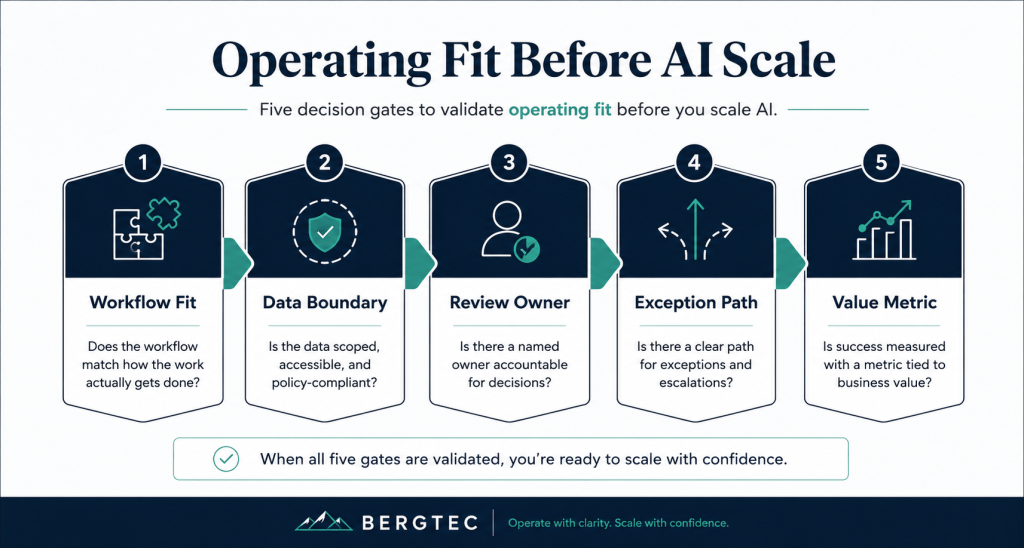
Before choosing the first or next AI use case, leaders should apply five operating-fit gates.
- Workflow fit
Can the current workflow be described clearly enough for AI to support it?
If the process is different every time, ownership is unclear, or the handoffs are informal, AI will expose that confusion quickly. Start where the workflow has enough structure to define the role of the tool.
- Data boundary
Can the organization define what information AI may use and what information stays out?
This is not only a technical question. It is a governance question. Leaders need to know which documents, records, systems, fields, and user roles are in scope before development or procurement moves too far.
- Review owner
Who is responsible for accepting, correcting, or rejecting the AI output?
Human review should not be a vague reassurance. It needs an owner, a standard, and a place in the workflow. If nobody owns review, the organization does not yet own the use case.
- Exception path
What happens when the AI output is incomplete, uncertain, inconsistent, or outside policy?
Useful operating models define the exception path before scale. That may include escalation rules, manual queues, second-level review, audit sampling, or limits on what the tool can produce.
- Value metric
What measurable improvement would make this use case worth continuing?
The metric should be tied to operating value, not novelty. Examples include reduced cycle time, fewer rework loops, faster intake review, improved consistency, lower backlog, better routing accuracy, or reduced administrative burden.
If a use case cannot pass these five gates, it may still be valuable later. It is probably not the right place to start.
Takeaway
AI adoption becomes more credible when leaders stop treating use-case selection as a brainstorming exercise and start treating it as an operating decision.
The first use case should create learning the organization can reuse. It should clarify data realities, review needs, exception patterns, workflow friction, and measurable value.
That is how AI moves from isolated experiments to repeatable adoption.
The leadership question is not, “Where can we show AI?”
The better question is, “Where can we operate AI responsibly enough to learn, improve, and scale?”


Leave a comment