
Problem
Technical founders often think a broad product is easier to sell.
In many B2B markets, breadth makes the first buying decision harder.
The product can support five workflows, three buyer groups, and a long list of future integrations. That may be true. It may also be the reason the buyer cannot decide what to fund first.
This is a common commercialization problem for technical founders, CEOs, product leaders, and early-stage teams selling into enterprise, healthcare, insurance, research, or operationally complex markets. The product has real capability. The team can demonstrate several valuable use cases. Prospects nod along because the possibilities are obvious.
Then the deal slows down.
Not because the product is weak. Not because the market has no need. Often, it slows because the founder has transferred too much decision work to the buyer.
The buyer now has to decide which use case matters most, who should own it, where the budget comes from, how implementation starts, what proof is enough, and how internal risk will be managed.
That is too much work for an early buying decision.
Insight
Commercialization does not reward maximum optionality at the start. It rewards decision clarity.
A technical product can have a broad architecture and still need a narrow commercial entry point. Those are not contradictions. In fact, many strong platforms need both: a scalable technical foundation and a focused first use case that a buyer can understand, fund, implement, and defend.
The founder sees the platform.
The buyer sees the first decision.
That distinction matters.
A broad product story often sounds impressive in a demo, but it can create uncertainty in procurement, budgeting, operations, and executive sponsorship. If three departments could use the product, which one goes first? If the product can solve multiple problems, which problem creates urgency? If the product can integrate with several systems, which integration is required for the first measurable outcome?
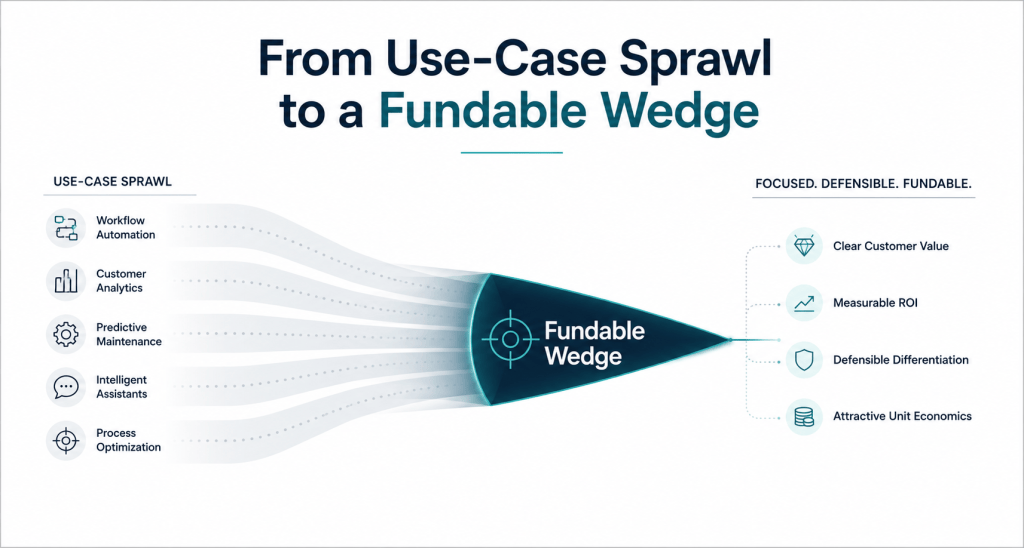
A fundable wedge answers those questions before the buyer has to.
It does not make the company smaller. It makes the first decision clearer.
Example
Consider a technical platform that could support workflow automation, customer analytics, predictive maintenance, and internal reporting. The founder positioned it as a flexible intelligence layer for operational teams. The demo landed well because each executive could imagine a different use case.
That was also the problem.
The COO cared about service backlog. The finance leader wanted better cost visibility. The product team wanted usage data. IT wanted to understand integration effort and data boundaries. Each conversation was positive, but no one owned the first decision.
The company had interest, but not a buying path.
The more useful move was to narrow the first commercial wedge: reduce service backlog in one operational workflow where the COO owned the outcome, the data came from two approved systems, and the first proof metric was cycle-time reduction over 60 days.
That changed the conversation.
The initial scope had a defined workflow owner. The data boundary was clear: no sensitive customer notes would be pulled into the first phase without review. The success metric was specific. The implementation handoff was practical: operations owned workflow adoption, IT approved the data connection, and the vendor supported setup and measurement.
The broader platform story did not disappear. It became the expansion path, not the first ask.
That is the commercial difference between “we can do many things” and “this is the first decision worth funding.”
Framework
A fundable wedge should answer five practical questions.
- Which buyer owns the pain?
Do not start with the broadest audience. Start with the person who has a real problem, authority to act, and a reason to care now.
If the product needs three executives to agree before anyone sees value, the wedge is probably too broad.
- Which workflow creates urgency?
A useful wedge attaches to a visible operating problem: delay, rework, missed revenue, avoidable cost, compliance exposure, service friction, or decision backlog.
The workflow should be specific enough that the buyer can say, “Yes, that is where the work breaks.”
- What proof makes the first step credible?
Early proof should not be abstract. Define what the buyer needs to see to justify the next step.
That may be cycle-time improvement, reduction in manual review, cleaner handoffs, faster onboarding, fewer exceptions, better utilization, or a measurable lift in conversion. The metric should fit the buyer’s operating reality.
- What implementation path feels manageable?
Many technical products lose momentum because the first implementation feels undefined.
A fundable wedge should clarify the first data source, the first user group, the first approval point, the first handoff, and the first success review. This does not require a massive deployment plan. It requires enough specificity to reduce buyer anxiety.
- How does the wedge expand?
A narrow wedge should not trap the company in a small story. It should create a credible path to broader adoption.
The best wedge is focused enough to buy and strong enough to expand. It creates evidence the founder can use in the next department, workflow, market, or partnership conversation.
Takeaway
Technical founders do not need to make the product sound smaller. They need to make the first buying decision more practical.
A broad capability can be a strength. But if the initial commercial story asks the buyer to sort through every possible use case, the product becomes harder to fund.
The better question is not, “How many things can this product do?”
The better question is, “Which first problem is specific enough, painful enough, and measurable enough that a buyer can act?”
Commercialization starts when capability becomes a decision someone can own.


Leave a comment