
Problem
AI can accelerate work quickly. It cannot decide who owns the consequences.
That is where many adoption efforts quietly weaken. The technology performs well enough to create momentum, but the organization has not decided who reviews the output, who handles exceptions, what data is appropriate, or when a human decision is still required.
For executives, product leaders, healthcare operators, insurers, research organizations, and regulated teams, this is not a minor implementation detail. It is the difference between a useful AI-enabled workflow and a risky automation layer sitting on top of unclear accountability.
The mistake is treating automation as the starting point.
A team identifies a repetitive process, runs a pilot, sees time savings, and moves toward deployment. But as soon as the workflow touches a real customer, member, patient, claim, research record, or financial decision, the operating questions become harder.
- Who is responsible if the AI summary misses context?
- Who can override the recommendation?
- What source data is off limits?
- What gets documented?
- When does the work move from assisted review to formal decision?
If those answers are vague, adoption becomes fragile. People may use the tool inconsistently. Compliance teams may slow the rollout. Managers may struggle to measure value. Frontline users may trust the output too much in one case and ignore it entirely in another.
The issue is not whether AI can help. The issue is whether the business has designed the accountability around how it helps.
Insight
AI adoption is often discussed as a tooling decision, a data decision, or a productivity decision. It is all three, but the practical adoption point is usually accountability.
Before leaders ask, “Can AI automate this?” they should ask, “Who remains accountable for the decision this workflow supports?”
That question changes the design.
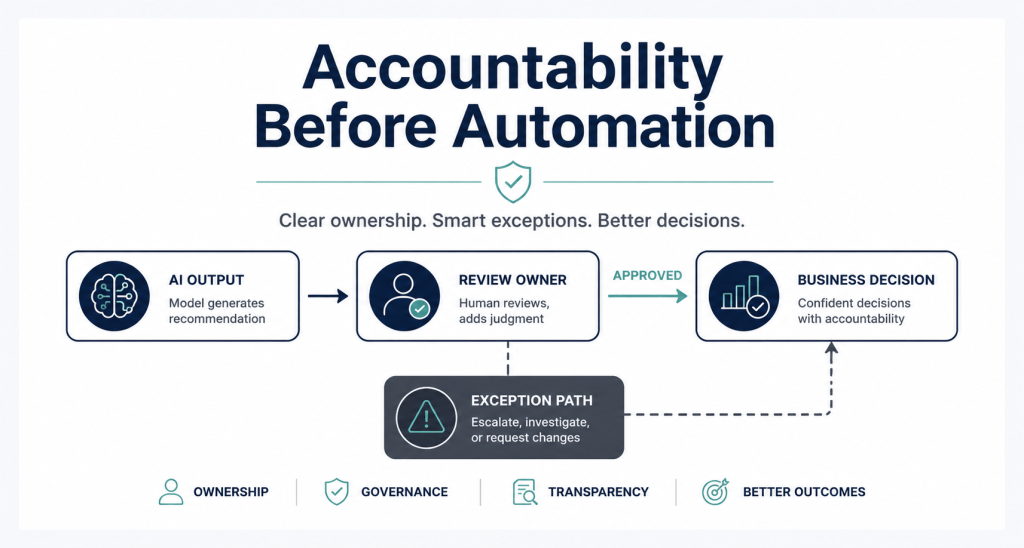
- If AI is summarizing documents, the design needs a review owner.
- If AI is recommending next actions, the design needs decision rights.
- If AI is drafting customer communication, the design needs approval rules.
- If AI is analyzing sensitive records, the design needs data boundaries.
- If AI is flagging exceptions, the design needs an escalation path.
Without that operating structure, automation creates speed without confidence. And speed without confidence does not scale well.
A useful AI workflow should make accountability more visible, not less.
That is especially important in environments where trust matters: healthcare, insurance, research, financial operations, enterprise service delivery, and any business where a wrong decision can create downstream risk.
Governance does not have to be heavy. But it does have to shape behavior. A policy sitting in a folder will not help the user at the moment they need to know whether to accept, edit, escalate, or reject an AI-generated output.
Accountability has to be designed into the workflow.
Example
Consider a common pattern in a healthcare-adjacent organization evaluating AI to support prior authorization review summaries.
The pilot looked promising. Staff could upload case materials, and the AI produced a structured summary faster than manual preparation. Leaders saw a practical opportunity: reduce administrative burden, help reviewers move faster, and improve consistency in how information was presented.
But the first operating review exposed the real work.
The team had to define which documents could be used as source material and which could not. Certain notes contained sensitive information that was not relevant to the authorization decision, so the workflow needed a data boundary.
They also had to assign a review owner. The AI could prepare the summary, but a trained reviewer had to confirm its clinical relevance before it influenced the next step. That owner needed clear authority to edit, reject, or escalate the output.
Then the exception path had to be designed. If the AI summary conflicted with a source document, the case could not proceed as normal. It had to move into a manual review queue with a documented reason code.
The handoff mattered too. Operations wanted faster throughput, but compliance needed evidence that reviewers were not treating AI output as the decision itself. The workflow had to separate “AI-assisted preparation” from “authorized business decision.”
The success metric also changed. The team did not measure only time saved. They tracked summary quality, reviewer edits, exception rates, and the percentage of cases requiring escalation.
That is the operating difference.
The AI capability created the opportunity. Accountability made it usable.
Framework
Before automating a workflow with AI, leaders should answer five accountability questions.
- What decision does this workflow support?
Be specific. “Improve efficiency” is not enough. Identify whether the AI is helping prepare information, recommend an action, draft communication, classify a case, prioritize work, or support a formal decision.
- Who owns the review?
Every AI-enabled workflow needs a named human or role accountable for review quality. If ownership is shared too broadly, it usually means no one owns it clearly enough.
- What data is allowed?
Define source data rules before deployment. Decide what information can be used, what must be excluded, what requires masking, and what should trigger additional review.
- What happens when the output is uncertain, incomplete, or disputed?
Exception handling should not be improvised. Define when users can edit, when they must escalate, and when the AI output should be discarded.
- How will the organization measure trust, not just speed?
Time savings matter, but they are not the whole picture. Track review edits, escalation rates, error patterns, user adoption, decision consistency, and downstream rework.
These questions turn AI adoption from a tool rollout into an operating design exercise.
They also help executives avoid a common trap: assuming that a successful pilot proves the workflow is ready. A pilot can prove capability. It does not automatically prove accountability, repeatability, or trust.
Takeaway
AI adoption does not fail only because the technology underperforms. It often fails because leaders automate work before assigning responsibility for how that work should be reviewed, governed, and improved.
The practical sequence matters.
Define the workflow.
Assign accountability.
Set data boundaries.
Design review and exception paths.
Then automate.
That order may feel slower at the beginning, but it reduces friction later. It gives users confidence, gives leaders better measurement, and gives boards, compliance teams, customers, and partners a clearer story about responsible adoption.
The strongest AI operating models do not hide judgment behind automation.
They make judgment easier to apply, easier to audit, and easier to improve.


Leave a comment