
Problem
Technical products do not usually stall because buyers miss the brilliance.
They stall because the first implementation step still feels like a custom project the buyer has to build from scratch.
That is a commercialization problem.
For many technical founders, the product is real. The demo works. The architecture is thoughtful. The use case is credible. But when a buyer asks, “How would we actually start?” the answer becomes too broad, too technical, or too dependent on discovery that has not yet been structured.
That hesitation matters because buyers do not only evaluate capability. They evaluate the work required to adopt it.
A founder may see flexibility. The buyer may see ambiguity.
If the buyer has to determine the workflow owner, data requirements, integration path, pilot scope, approval process, and success metric before they can even justify the first step, the sales process slows down. Not because the product lacks value, but because the path to value is unclear.
A buyer should not need to become your implementation architect before they can say yes.
Insight
Commercialization is not just positioning the value proposition. It is packaging the first credible operating step.
Technical founders often want to preserve optionality. They can support multiple use cases, user types, configurations, and integration paths. That flexibility may be technically true, but it can make the buying decision harder.
Executives and operating leaders are usually asking a more practical set of questions:
- Who owns this internally?
- Where does it fit in the workflow?
- What data does it need?
- How disruptive will implementation be?
- What proof will tell us this is worth expanding?
If those questions are not answered clearly, the product remains interesting but difficult to act on.
This is especially important in healthcare, insurance, research, enterprise software, and other operating environments where new technology must fit into existing workflows, decision rights, data boundaries, compliance expectations, and budget logic.
The issue is not that every implementation must be simple. Many valuable products require meaningful operational change. The issue is whether the buyer can see the first step clearly enough to fund, staff, and defend it.
Example
A common pattern shows up with technical analytics platforms.
The founder has built a strong product that can surface operational insights from complex data. In the demo, the platform identifies risk patterns, workflow delays, utilization trends, or performance gaps that leadership cares about. The reaction is positive.
Then the commercial process slows.
The buyer is not rejecting the concept. They are trying to understand how adoption would actually begin.
One executive assumes the pilot belongs with operations. Another thinks data governance needs to approve the source files first. The product team wants to know whether the initial use case is retrospective analysis or a live workflow trigger. The IT group asks whether the first version requires integration or can run from a controlled extract. Legal or compliance wants to know which data fields are required and whether any sensitive data can be excluded.
None of these questions mean the product is weak. They mean the implementation package is not yet concrete enough.
The practical shift is to define a narrower first step:
- One operating owner.
- One priority workflow.
- One approved data boundary.
- One low-friction implementation path.
- One success metric that leadership can understand.
For example, instead of selling the platform as an enterprise analytics layer, the founder may package the first step as a 60-day operational review for a defined workflow. The data boundary is limited to an approved historical extract. The operating owner is named before kickoff. The first success metric is not “AI-driven insight generation.” It is something clearer, such as reduced manual review time, improved exception visibility, or a prioritized list of workflow bottlenecks for leadership action.
That changes the conversation.
The buyer is no longer being asked to imagine an entire future state. They are being given a credible first step in operations.
Framework
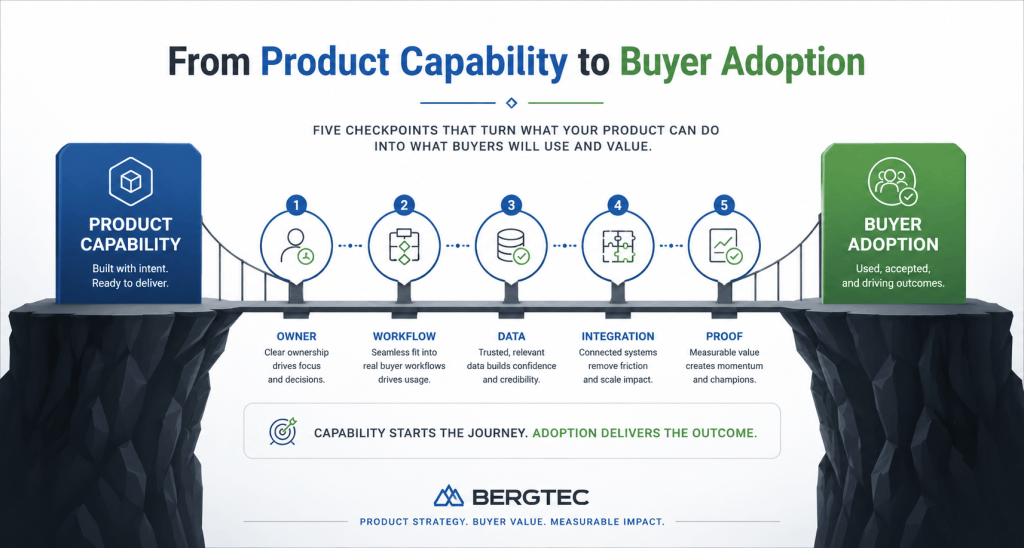
Technical founders can improve commercialization by defining five implementation-readiness checkpoints before the next serious buyer conversation.
- Who owns the first use case?
Do not leave ownership vague. Identify whether the first buyer-side owner is operations, product, clinical leadership, finance, IT, compliance, or another function. If ownership is split, define the primary decision owner and the supporting reviewers.
- What workflow does the product enter first?
Avoid selling the product as broadly useful. Name the first workflow where it belongs. Is it intake review, reporting, scheduling, claims analysis, member engagement, field operations, customer onboarding, or executive reporting? Specific workflow placement makes value easier to evaluate.
- What data is required, restricted, or optional?
Buyers need to know the data boundary. Define the minimum viable data set, sensitive fields that can be excluded, refresh requirements, and whether the first step can work from an extract before deeper integration. Data clarity reduces perceived implementation risk.
- What is the lightest credible implementation path?
Not every buyer is ready for a full integration. Determine whether the first step can be run in a sandbox, via manual upload, with a limited API connection, in a pilot environment, or through a controlled operational review. The goal is not to avoid technical depth. The goal is to sequence it intelligently.
- What proof will justify the next decision?
A pilot should not end with “people liked it.” Define the decision evidence in advance. That may include time saved, error reduction, adoption by a defined user group, improved visibility, reduced backlog, better prioritization, or executive confidence in a repeatable workflow.
These checkpoints do not make the product smaller. They make the first decision clearer.
Takeaway
Technical founders often think commercialization means explaining the product better.
Sometimes the more important work is making the first implementation step easier to understand.
That does not mean oversimplifying the technology. It means translating capability into a practical path a buyer can own, approve, fund, and measure.
Strong products earn attention. Clear implementation packages create movement.


Leave a comment