
Problem
A compelling growth story can open the conversation.
It cannot carry diligence by itself.
This is where many promising companies feel the gap between momentum and readiness. Revenue is growing. Customers are interested. The product has traction. The leadership team can explain the market opportunity.
Then investors, board members, or strategic partners start asking harder questions.
Which customers are most repeatable?
How predictable is the sales motion?
What evidence shows the team can deliver consistently?
Where does risk sit in the operating model?
What has to be true for this growth plan to scale?
Those questions are not distractions from the story. They are the test of whether the story can survive contact with execution.
Boards and investors do not only want ambition. They want evidence that the business can repeat what it says is working.
Insight
Investor readiness is often misunderstood as a better deck, cleaner financial model, or sharper market narrative.
Those things matter. But they are not enough.
A strong investor narrative should be supported by operating evidence: customer patterns, sales discipline, delivery capacity, governance cadence, risk visibility, and proof that the company knows which growth signals are meaningful.
The issue is not whether the company has potential. The issue is whether the leadership team can show how potential becomes repeatable performance.
This is especially important for technical, healthcare, AI, mobile, and regulated businesses, where execution risk is often buried inside implementation details. A company may have a strong product, but if buyer segments are inconsistent, implementation depends on heroic effort, data risks are loosely managed, or success metrics change from customer to customer, diligence will expose the weakness.
The board-level question is simple:
Can this company do more of what is working without breaking the operating model?
Example
Consider a growth-stage technology company preparing for investor conversations.
The company has several strong customer examples. Revenue is increasing. The team has built a credible product and can point to enthusiastic users. On the surface, the story is attractive.
But when the leadership team starts preparing for diligence, the evidence is uneven.
Customer wins come from three different segments, each with a different buyer, sales cycle, use case, and implementation path. The sales team cannot clearly explain which segment to prioritize. Delivery depends heavily on the founder and one senior technical lead. Customer success tracks adoption informally, but there is no consistent metric across accounts. Security and data questions are handled on a case-by-case basis rather than through a repeatable review process.
None of this means the company is weak. It means the company is not yet presenting repeatability clearly.
The work shifts from storytelling to readiness.
The team narrows the investor narrative around the most repeatable customer segment. It documents the sales motion from first conversation to signed agreement. It defines the proof points that matter: sales cycle length, implementation time, adoption within the first 60 days, renewal signals, and support burden. It assigns delivery ownership to someone other than the founder. It creates a basic governance cadence for security, data access, and customer exceptions.
Now the company can tell a stronger story because it is backed by operational evidence.
That is what boards and investors are really testing.
Framework
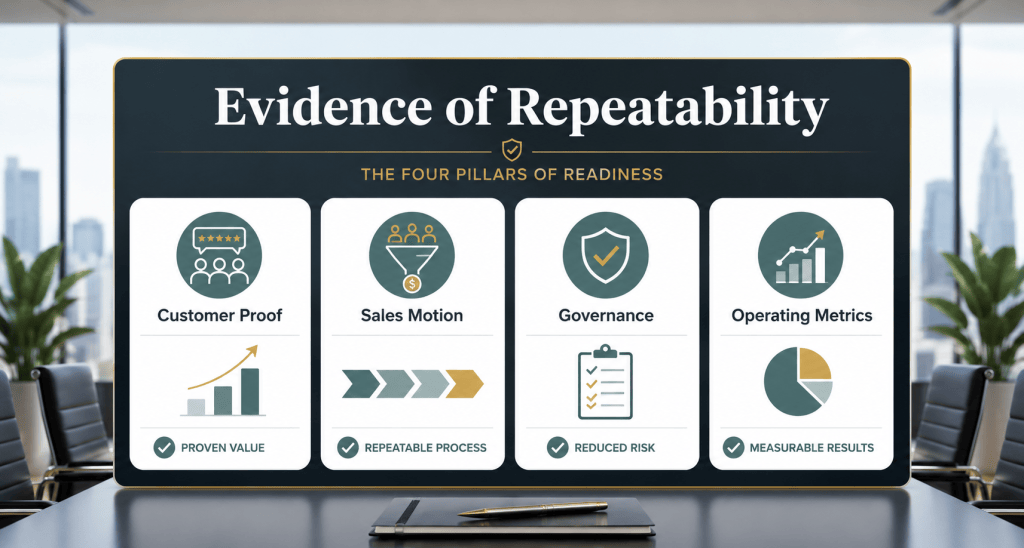
Before entering investor, board, or strategic partner conversations, leadership teams should pressure-test five areas of repeatability.
- Repeatable customer segment
Which customer pattern is strongest?
Not every customer win should carry equal weight in the growth story. Identify the segment where pain, buyer ownership, willingness to pay, implementation fit, and proof of value are most consistent.
A scattered customer base may show interest. A repeatable segment shows commercial direction.
- Repeatable sales motion
Can the team explain how deals actually move?
Investors will look for evidence that sales progress is not dependent on founder charisma, one-off relationships, or custom education. The company should be able to describe the buyer, trigger event, proof requirement, decision path, common objections, and budget owner.
If every deal is different, growth may be real but hard to forecast.
- Repeatable delivery model
Can the company deliver without heroic effort?
This is where many technical companies underestimate diligence risk. A strong product still needs a workable implementation path, clear ownership, a support model, an onboarding process, and an escalation route.
Delivery discipline turns early wins into scalable evidence.
- Repeatable governance and risk management
Are important risks managed consistently?
For AI, healthcare, insurance, research, enterprise, and data-sensitive businesses, governance cannot be improvised in each customer conversation. Leaders should be able to explain data boundaries, review points, decision rights, security posture, and exception handling.
Governance becomes credible when it shapes operating behavior.
- Repeatable metrics
Does the company know which evidence matters?
Vanity metrics rarely survive serious diligence. Leadership should focus on measures that show commercial and operating maturity: conversion rate, sales cycle length, implementation time, adoption depth, retention signals, gross margin, support burden, and customer expansion patterns.
Metrics should help the board and investors understand what is working, what is fragile, and what must improve.
Takeaway
Investor readiness is not just about making the company sound more attractive.
It is about making the company easier to understand, test, and trust.
A strong growth story matters, but the strongest stories are supported by evidence of repeatability: who buys, why they buy, how the company delivers, where risks are managed, and which metrics prove progress.
Boards and investors are not only evaluating the upside. They are evaluating whether the operating model can carry the upside.
That is where readiness becomes strategic.


Leave a comment