
Problem
Buyer interest can feel like traction.
But interest that does not translate into a decision is still commercial friction.
This is a common trap for technical founders, especially when the product is capable, flexible, or technically impressive. Prospects like the demo. Advisors say the market is real. Potential partners ask for updates. A few executives say, “This is interesting.”
Then the sales process slows down.
Not because the product has no value. Often the product does have value. The problem is that the buyer still has too much work to do.
They have to translate the use case. They have to decide who owns the budget. They have to explain the problem internally. They have to compare the product against doing nothing. They have to guess what proof is enough. They have to imagine the first implementation step.
That is not a sales conversation. That is unpaid commercialization labour being pushed onto the buyer.
A commercial package should make the decision easier, not more impressive.
Insight
Technical founders often respond to slow momentum by adding more explanation.
More features. More diagrams. More technical detail. More optional use cases. More examples of what the platform could become.
But the missing piece is usually not more information. It is decision clarity.
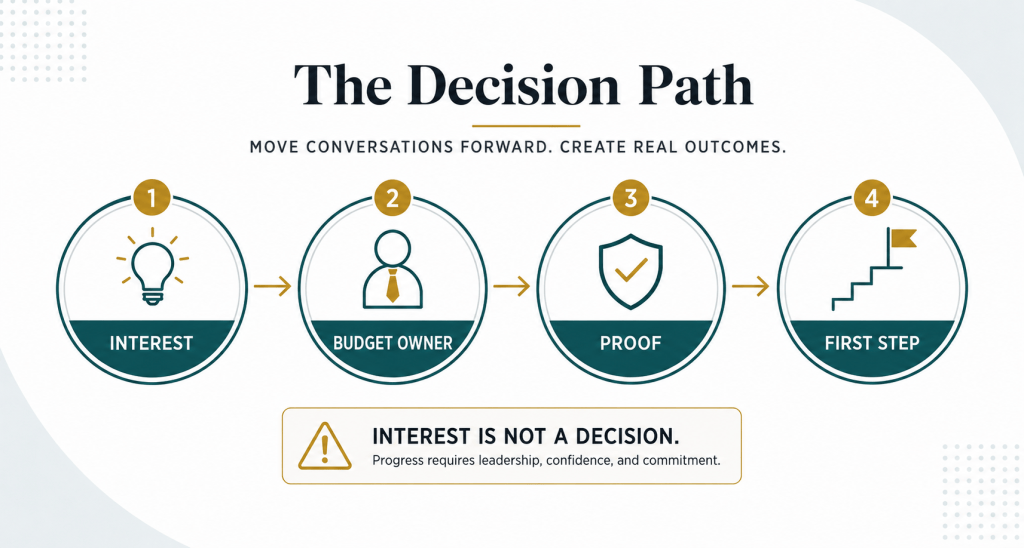
A buyer does not fund potential in the abstract. They fund a practical decision they can understand, defend, and implement.
That means the founder has to answer a different set of questions:
Who is this for first?
What painful workflow or business problem does it solve?
Why does that buyer care now?
Who owns the decision?
What proof lowers risk?
What is the first step after yes?
These questions may feel less exciting than product vision. But they are the questions that move a technical product from admiration to adoption.
Founders see optionality as strength. Buyers often see optionality as work.
The more flexible the product, the more disciplined the commercial packaging needs to be.
Example
Consider a technical founder selling a workflow platform into a regulated services market.
The product can support several use cases: intake management, internal review, status tracking, document routing, and customer communication. In demos, prospects respond well because almost everyone can see something useful.
But the pipeline does not move cleanly.
One prospect sends the founder to operations. Operations likes the workflow visibility but says IT needs to review integration requirements. IT asks whether compliance has approved the data model. Compliance asks who owns the decision. The original executive sponsor says the team needs a clearer business case before budget can be discussed.
Nothing is necessarily wrong with the product. The problem is that the buying path was not designed.
The founder eventually narrows the first commercial package around one beachhead use case: reducing intake rework for mid-sized regulated service providers.
That choice changes the conversation.
The budget owner becomes the operations executive responsible for throughput and service quality. The buyer language shifts from “configurable workflow platform” to “reduce incomplete intake handoffs before they slow down review.” The proof threshold becomes measurable: lower rework rate, shorter review cycle time, and fewer cases returned for missing information. The first implementation step becomes a focused pilot in one intake queue, with defined data fields, reviewer roles, and weekly exception reporting.
The product did not become smaller. The decision became clearer.
That is commercialization work.
Framework
Before pursuing more interest, technical founders should pressure-test whether they have packaged a real buying decision.
- Name the first buyer
A broad market is not the same as an initial buyer.
Define the first practical buyer by role, problem, operating context, and urgency. “Healthcare organizations” is too broad. “Operations leaders managing intake rework across multiple service teams” is closer to a decision.
If the buyer is unclear, the message will drift.
- Translate the capability into buyer language
Technical capability explains what the product can do. Buyer language explains why the buyer should care.
The founder may describe automation, architecture, configurability, analytics, or integration flexibility. The buyer may care about cycle time, fewer handoffs, lower rework, improved visibility, or reduced manual coordination.
Commercialization requires translation.
- Define the decision owner
Many early sales conversations fail because everyone is interested and no one owns the decision.
Identify who feels the operational pain, who controls budget, who must approve risk, and who will be accountable after implementation. These may be different people.
A buying process is rarely blocked by one objection. It is often slowed by unclear ownership.
- Set the proof threshold
Founders often assume that a strong demo should be enough. It usually is not.
Define what evidence would make the first decision credible. That might be a pilot metric, a workflow comparison, a customer reference, a security review, a cost model, or a before-and-after operating measure.
Proof should reduce the buyer’s perceived risk, not just show the product in a favourable light.
- Make the first step concrete
A buyer should not have to invent the starting point.
Define the first implementation motion: scope, timeline, users, required data, handoffs, success metric, and the decision point after the pilot or initial deployment.
The easier it is to understand the first step, the easier it is to say yes.
Takeaway
Technical founders do not need to make the product sound bigger in every conversation.
They need to make the buying decision clearer.
That means narrowing the first use case, naming the buyer, translating the value into operating language, defining proof, and giving the prospect a practical first step.
Interest is useful. But interest alone does not create revenue, adoption, or market credibility.
The founder’s job is not only to show what the product can do. It is to help the buyer understand why this decision makes sense now.


Leave a comment