
Problem
AI value does not disappear because leaders cannot imagine use cases.
It disappears because no one defines where the work changes.
For CEOs, product leaders, operating executives, and boards, this is one of the most common AI adoption traps. A team launches a promising pilot. The tool performs well enough. People are interested. A few users see productivity gains.
Then the ROI discussion gets slippery.
Did the organization reduce cycle time? Improve decision quality? Lower rework? Increase throughput? Shorten review queues? Reduce avoidable escalation? Create capacity without adding headcount?
Too often, no one can answer cleanly because the AI effort was measured as a tool activity instead of an operating change.
The problem is usually not that AI has no value. The problem is that the value was never attached to a defined workflow, owner, review point, or business metric.
AI ROI is not found in the demo. It is found in the redesigned work.
Insight
Leaders often ask, “What is the ROI of this AI tool?”
A better question is, “Which workflow will change, who owns that change, and what operating result should improve?”
That shift matters because AI adoption is not a technology event. It is a management decision about how work should move through the organization.
If AI is used to summarize documents, the ROI is not “summaries created.” It may be shorter intake review time, fewer missed exceptions, faster triage, or better preparation for a human reviewer.
If AI is used to support customer service, the ROI is not “answers generated.” It may be lower escalation volume, faster first response, more consistent routing, or improved supervisor review capacity.
If AI is used in product, compliance, research, healthcare, insurance, or enterprise operations, the same rule applies: the metric has to sit inside the workflow, not beside it.
Governance also becomes more useful in this context. It is not only a policy layer. It is the operating discipline that defines what the system can and cannot touch, when people review output, and how exceptions are handled.
Without that discipline, AI adoption becomes a collection of isolated productivity stories. Useful, perhaps, but hard to defend as an operating investment.
Example
Consider a common pattern: an organization wants to use AI to accelerate intake review for a high-volume operational process.
The pilot looks encouraging. The tool can summarize submitted materials, identify missing information, and suggest a recommended category for routing. Early users like the speed. Leaders see potential.
But the work stalls when the team tries to scale it.
The issue is not model performance alone. The issue is that the operating model was incomplete.
A few practical questions had not been settled:
Who owns the final routing decision?
Which data fields are allowed into the AI-assisted review step?
What information must stay outside the workflow because of privacy, contractual, or regulatory constraints?
When does a human reviewer override the system?
What happens when the AI output is incomplete, low-confidence, or inconsistent with the source material?
Which metric matters most: cycle time, accuracy, reviewer capacity, exception reduction, or downstream rework?
Once those questions are answered, the AI use case becomes much clearer.
The organization might decide that AI can summarize intake materials and flag missing fields, but cannot make final eligibility or priority decisions. A trained operations reviewer owns the decision. Sensitive attachments stay outside the model workflow unless specifically approved. Exceptions route to a supervisor when required fields are missing, confidence is low, or the case involves a defined risk category.
Now ROI can be measured against the actual operating design: average intake review time, percentage of cases requiring rework, reviewer throughput, exception volume, and supervisor escalation rate.
That is a very different conversation from “the AI tool saves time.”
It gives leaders something they can manage.
Framework
Before asking whether an AI initiative has ROI, leaders should define five operating checkpoints.
- Workflow fit
Where exactly will AI enter the work?
Not “document review” in general. Not “customer service” in general. Define the specific step, handoff, queue, or decision-support moment where AI will be used.
If the workflow cannot be named, measuring ROI will be difficult.
- Decision rights
Who owns the final decision?
AI can support judgment, prepare materials, identify patterns, or recommend next steps. But someone still needs to own the business decision, especially in regulated, sensitive, or customer-impacting workflows.
Unclear decision rights create resistance to adoption and governance risk.
- Data boundaries
What information can the system use?
Teams need to define permitted data sources, restricted data, retention expectations, and any information that requires special handling before development or rollout.
Data boundaries are not administrative details. They shape trust.
- Review and exception rules
When does a person review the output?
Human review should not be vague. Define the review point, reviewer role, escalation trigger, override rule, and exception path.
This is where governance becomes operational instead of decorative.
- Success metric
What operating result should improve?
Pick a small number of measurable outcomes tied to the workflow. Examples include cycle time, rework rate, escalation rate, throughput, decision consistency, customer response time, or cost per completed process.
If the metric is only “usage,” the organization may prove activity without proving value.
Takeaway
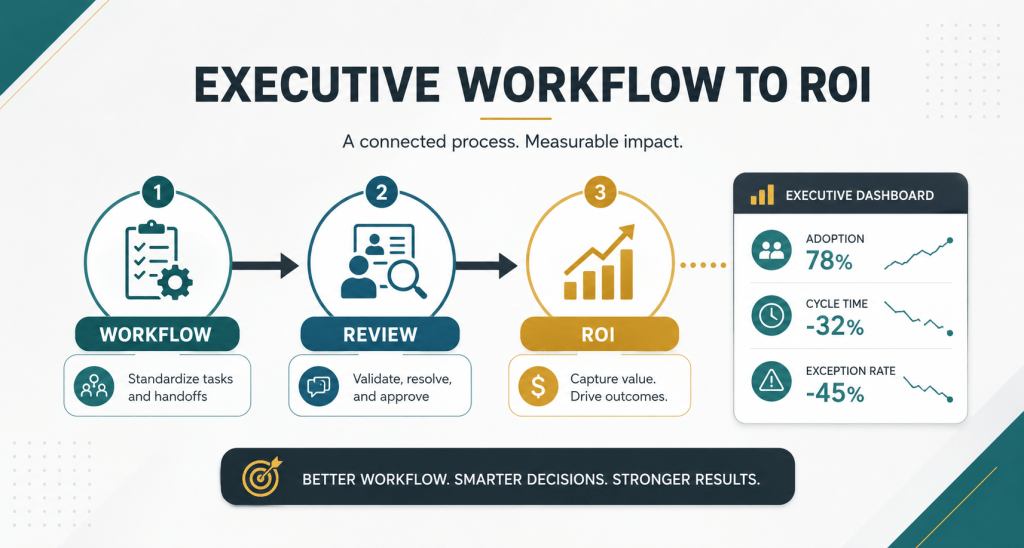
AI adoption becomes credible when leaders stop treating ROI as a generic technology question and start treating it as a workflow design question.
The commercial and operational value of AI depends on where it fits, who reviews it, what data it can use, what exceptions it creates, and which business result it improves.
This is why workflow should come before tooling.
A strong AI operating model does not slow adoption. It makes adoption more measurable, more trusted, and easier to defend.


Leave a comment